



The Oman 2040 document is a national vision plan for the future of Oman that outlines the country’s development path until 2040. Based on the information in the text, this document has the following features:
This document is described as “the Sultanate’s gateway to overcome challenges, keep pace with regional and global changes, create and exploit opportunities to strengthen economic competitiveness and social welfare, stimulate growth and build trust in all economic, social and development relations throughout the country.” is

National priorities of document 2040
- Education, learning, scientific research, and national capabilities
- health
- Citizenship, identity, and cultural heritage
- Welfare and social support
- Leadership and economic management
- Economic diversity and financial stability
- Labor market and employment
- The private sector, investment, and international cooperation
- Development of provinces and sustainable cities
- Environment and natural resources
- Legislative, judicial, and regulatory system
- Governance of administrative institutions, resources, and government projects
These priorities are the key areas that Oman intends to focus on to achieve the goals of Vision 2040. They cover a wide range of aspects of social, economic, and institutional development.
Education, learning, scientific research, and national capabilities
This index focuses on improving the quality of the educational system, strengthening scientific research and innovation, and developing national talents.
Goals
- High-quality educational system and social participation
- A system for empowering human capabilities in the education sector
- Effective national system for fostering scientific research, innovation, and creativity
- Diverse and sustainable funding sources for education and scientific research
- National talents with dynamic and competitive capabilities and skills
- Value-oriented curricula based on Islamic principles and Omani identity
Numerical and comparative indicators
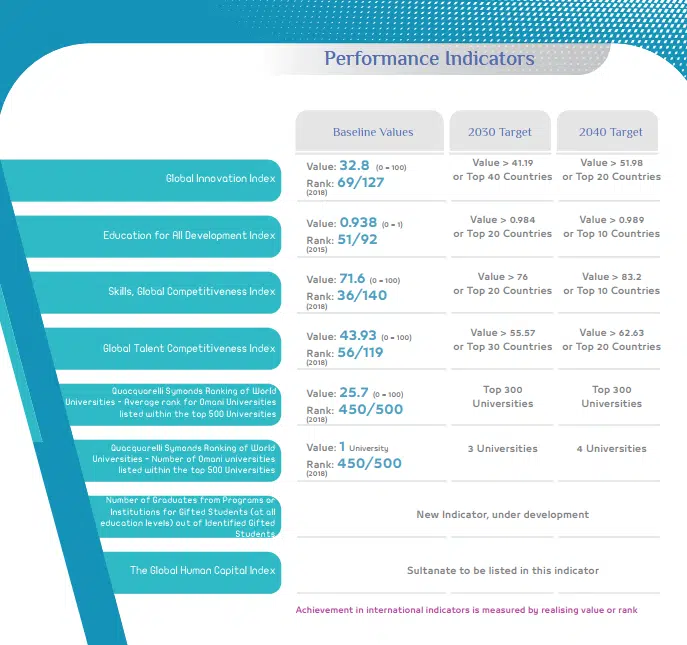
Global Innovation Index (GII)
The Global Innovation Index (GII) is an annual ranking of countries based on their ability to innovate, published by the World Intellectual Property Organization (WIPO). This index was launched in 2007 by INSEAD and World Business, a British magazine. By 2021, WIPO will publish it in collaboration with Cornell University, INSEAD, and other organizations and institutions.
This index is prepared based on subjective and objective data from various sources, including the International Telecommunication Union, the World Bank, and the World Economic Forum.
The goal of GII
The GII aims to provide as comprehensive a picture of innovation as possible. This index consists of about 80 indicators that measure criteria such as political environment, education, infrastructure, and knowledge creation in each economy.
GII Topics
Every two years, the GII covers a topic related to innovation that goes beyond innovation rankings. In 2020, the topic “Who will fund innovation?” reviewed the state of innovation financing by examining the evolution of existing mechanisms and pointing out progress and remaining challenges. Previous GII topics have included health innovation, environmental innovation, agricultural and food innovation, and more.
Numerical index
- Base value: 32.8 (ranked 69 out of 127 in 2018)
- 2030 goal: above 41.19 or among the top 40 countries
- 2040 goal: above 51.98 or among the top 20 countries
Education development index for all
The Education for All Development Index (EDI) is a composite indicator developed by UNESCO to measure countries’ progress in achieving the Education for All (EFA) goals. This indicator covers the four main goals of EFA:
- Global Primary Education: Global enrollment in primary education and its completion.
- Adult literacy: improving the level of adult literacy.
- Gender Equality and Equity: Eliminating Gender Inequalities in Education.
- Quality of education: improving the quality of education.
Numerical index
- Base value: 0.938 (ranked 51 out of 92 in 2015)
- 2030 goal: above 0.984 or among the top 20 countries
- 2040 goal: above 0.989 or among the top 10 countries
Skills (global competitiveness index) :
The Global Competitiveness Index (GCI), published by the World Economic Forum (WEF), considers skills as one of the critical pillars of a nation’s competitiveness. Here’s how skills relate to GCI:
Specific pillar: GCI assesses a country’s competitiveness in 12 pillars: education and skills. This column focuses on the quality of a nation’s education system and workforce skills.
Numerical index
- Base value: 71.6 (ranked 36 out of 140 in 2018)
- 2030 goal: above 76 or among the top 20 countries
- 2040 goal: above 83.2 or among the top 10 countries
Global Talent Competitiveness Index (GTCI)
The Global Talent Competitiveness Index (GTCI), published by INSEAD in partnership with other organizations, is a comprehensive report that measures how well countries cultivate, attract and retain talent.
Difference from GCI: Unlike the GCI, which deals with competitiveness in general, the GTCI focuses specifically on a country’s ability to develop, attract and retain skilled workers.
Structure: GTCI uses a framework with three main categories:
- Talent Pipeline: This topic assesses a country’s education system, lifelong learning opportunities, and access to skilled professionals.
- Attracting talent: This assesses how open a country is to attracting foreign talent through immigration policies and the overall attractiveness of the labor market.
- Talent Empowerment: This topic analyzes the factors influencing how a country retains talent, such as the work environment, quality of life, and access to career development opportunities.
Rankings: GTCI ranks countries based on their overall score, providing a clear picture of which countries are most successful in nurturing and attracting talent.
Advantages: GTCI is a valuable tool for policymakers, businesses, and individuals. This helps them:
- Policymakers should identify areas for improvement in their education systems and talent development strategies.
- Businesses find out which countries have the most skilled workforce.
- Individuals seeking international careers should research potential destinations based on the competitiveness of their talent.
Additional tips:
- GTCI covers many countries and provides insight into the global talent landscape.
- The GTCI highlights the disparities in talent competitiveness between developed and developing countries.
- This report is published annually and allows progress to be tracked over time.
Numerical index
- Base value: 43.93 (ranked 56 out of 119 in 2018)
- 2030 goal: above 55.57 or among the top 30 countries
- 2040 goal: above 62.63 or among the top 20 countries
Quacquarelli Symonds World University Rankings – average ranking of Omani universities among the top 500 universities:
- Base value: 25.7, with a rank of 450 out of 500 in 2018
- 2030 and 2040 goal: among the top 300 universities
The number of Omani universities among the top 500 universities in the world:
- Base amount: 1 university in 2018
- 2030 goal: 3 universities among the top 500 universities in the world
- Goal 2040: 4 universities among the top 500 universities in the world
These indicators show that Oman intends to:
Significantly improve its position in education, innovation, and talent development and advance in global rankings.
health
This index seeks to create a leading health system with international standards. Its goals include creating a healthy society free from health risks, developing technology-based medical systems, and training national talents in medical research and innovation.
Goals
- A healthy society free from health risks
- Qualified national talent to drive scientific research and innovation in healthcare
- High-quality healthcare and technology-based medical systems and services
- Decentralized health system with quality, transparency, fairness, and accountability
- Diversified and sustainable sources of financing for the health system
Numerical and comparative indicators
Health index, Legatum welfare index:
The Legatum prosperity index is a valuable tool for measuring the prosperity and well-being of countries. The Legatum health index is an important sub-base of this index that focuses on a country’s overall health. By understanding the factors that can contribute to a country’s overall health, we can work to improve the health and well-being of all people.
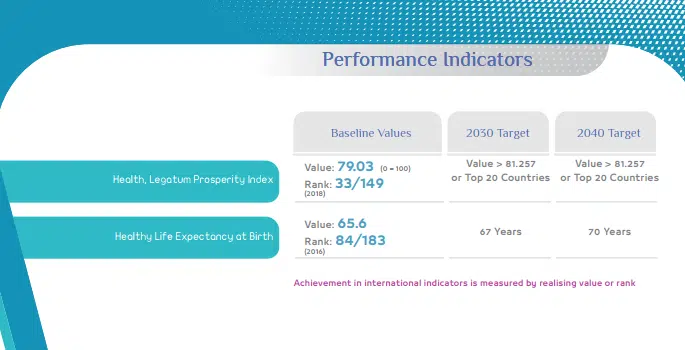
- Base value: 79.03 (ranked 33 out of 149 countries in 2018)
- 2030 goal: above 81,257 or among the top 20 countries
- 2040 goal: above 81,257 or among the top 20 countries
Healthy life expectancy at birth:
- Base value: 65.6 years (ranked 84 out of 183 countries in 2016)
- 2030 goal: 67 years
- Goal 2040: 70 years
These indicators show that Oman intends to:
- Improve your health status and join the global ranking of the top 20 countries in the Legatum Health Index.
- Significantly increase healthy life expectancy, to increase it by 4.4 years by 2040.
These goals show Oman’s commitment to:
Significant improvement in the healthcare system and health outcomes for its population. The focus on increasing healthy life expectancy shows that Oman is looking to increase life expectancy and improve quality of life and health throughout life.
Citizenship, identity, and cultural heritage
This index focuses on strengthening national identity, culture, and sense of citizenship. Its goals include creating a society proud of its identity and culture, fostering mutual understanding and coexistence globally, and sustainable investment in heritage, culture, and the arts.
Goals
- A society proud of its identity and culture and committed to citizenship
- A society capable of evaluating, challenging, investing, producing, and disseminating knowledge
- A leading society in the fields of mutual understanding, coexistence, and world peace
- A society with responsible members who are aware of their rights and are committed to their duties
- Professional media that strengthen social awareness and contribute to socio-economic development
- Sustainable investment in heritage, culture, and arts to contribute to national economic development
Numerical and comparative indicators
Security, global competitiveness index:
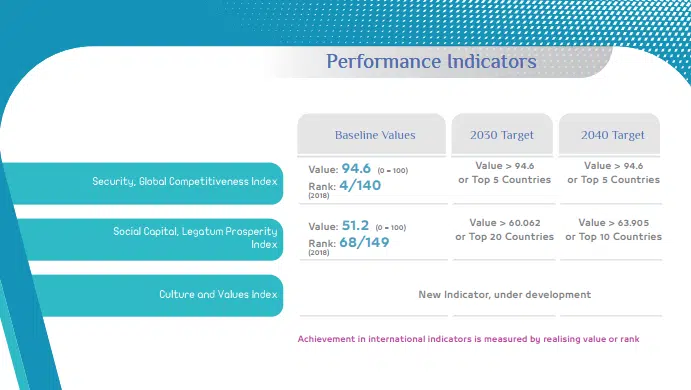
- Base value: 94.6 (4th rank out of 140 countries in 2018)
- 2030 goal: above 94.6 or among the top 5 countries
- 2040 goal: above 94.6 or among the top 5 countries
Social capital, Legatum welfare index:
- Base value: 51.2 (ranked 68 out of 149 countries in 2018)
- 2030 goal: above 60,062 or among the top 20 countries
- 2040 goal: above 63,905 or among the top 10 countries
Culture and values index :
This is a new index being developed, and its base values and goals have not yet been determined.
These indicators show that Oman intends to:
- Maintain its strong position in security and remain among the top 5 countries in the world.
- Significantly improve its social capital to reach the top 10 countries by 2040.
- Create a new indicator to measure and track progress on culture and values.
These goals show Oman’s commitment to:
Maintaining security is strengthening social ties and cultural values. Focusing on social capital shows Oman seeks to enhance social relations, trust, and civic participation. Also, developing a new index for culture and values shows that Oman attaches great importance to preserving and promoting its identity and cultural heritage.
Welfare and social support
This index seeks to improve the quality of life and provide social support for all citizens. Its goals include creating an effective and sustainable social safety net, empowering civil society, and providing advanced social services.
Goals
- A society with insurance coverage through a practical, stable, and fair social safety net
- Effective partnership between the government, private sector, and civil society in various fields of social development
- Empowered civil society with effective participation in sustainable development, a suitable environment and ecosystem for sports to participate in the economy and global competition, advanced social services, and programs that meet the needs of society.
- Targeted integrated social support for vulnerable groups
Numerical and comparative indicators
Social progress index:
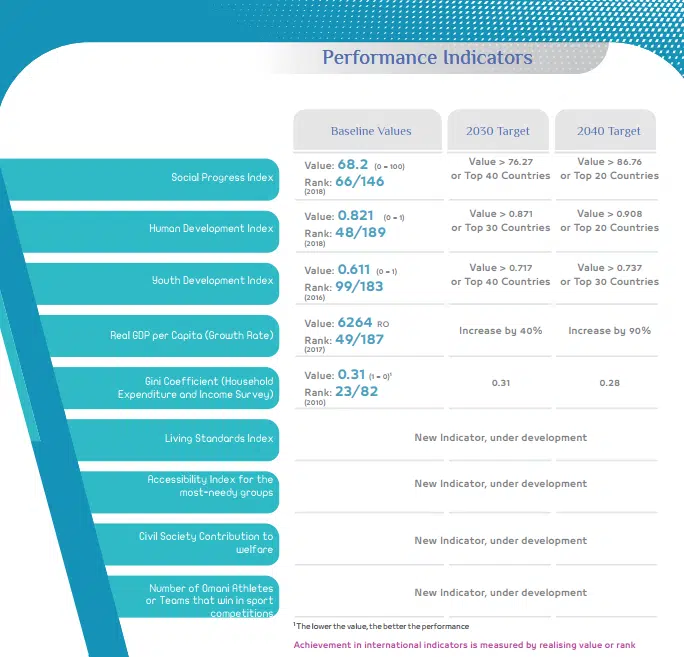
- Base value: 68.2 (ranked 66 out of 146 countries in 2018)
- 2030 goal: above 76.27 or among the top 40 countries
- 2040 goal: above 86.76 or among the top 20 countries
Youth Development Index:
- Base value: 0.611 (ranked 99 out of 183 countries in 2016)
- 2030 goal: above 0.717 or among the top 40 countries
- 2040 goal: above 0.737 or among the top 30 countries
Real GDP per capita (growth rate):
- Base amount: 6264 Omani rials (ranked 49th out of 187 countries in 2017)
- 2030 goal: 40% increase
- 2040 goal: 90% increase
Gini coefficient (checking household income and expenses):
- Base value: 0.31 (ranked 23 out of 82 countries in 2010)
- 2030 goal: 0.31
- Target 2040: 0.28
Living standards index:
This is a new index that is being developed.
Participation of civil society in welfare:
This is a new index that is being developed.
Access index for needy groups:
This is a new index that is being developed.
The number of Omani athletes or teams that win sports competitions:
This is a new index that is being developed.
Human Development Index:
- Base value: 0.821 (ranked 48 out of 189 countries in 2018)
- 2030 goal: above 0.871 or among the top 30 countries
- 2040 goal: above 0.908 or among the top 20 countries
These indicators show that Oman intends to:
Significantly improve their welfare and social protection status, focusing on social progress, youth development, economic growth, inequality reduction, and overall human development.
Leadership and economic management
This index focuses on improving the country’s economic leadership and management. Its goals include creating an integrated institutional framework for financial management, developing senior management capabilities, and creating a flexible and up-to-date regulatory environment.
Goals
- A competent reference institution for realizing the goals of economic development, social justice, and environmental protection
- Top management with constantly updated capabilities to keep pace with market dynamics
- The solid and effective economic legal framework in line with contemporary developments
- Research and development ecosystem in different departments and institutions
- Effective economic leadership with binding authority and a clear mission
Numerical and comparative indicators
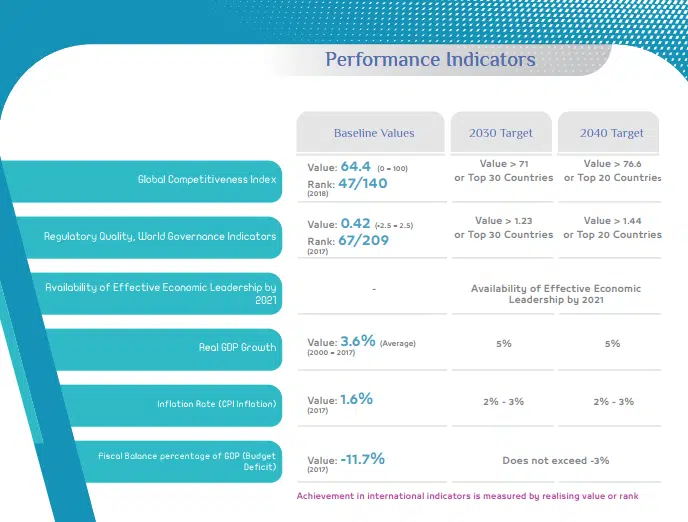
Global competitiveness index:
- Base value: 64.4 (ranked 47 out of 140 countries in 2018)
- 2030 goal: above 71 or among the top 30 countries
- 2040 goal: above 76.6 or among the top 20 countries
Legislative quality, global governance indicators:
- Base value: 0.42 (ranked 67 out of 209 countries in 2017)
- 2030 goal: above 1.23 or among the top 30 countries
- 2040 goal: above 1.44 or among the top 20 countries
Real GDP growth:
- Baseline: Average 3.6% until 2017
- 2030 and 2040 target: 5%
Availability of effective economic leadership by 2021:
This is a qualitative goal that must be achieved by 2021.
Inflation rate (consumer price index inflation):
- Baseline: 1.6% in 2017
- 2030 and 2040 goal: between 2% and 3%
Financial balance as a percentage of GDP (budget deficit):
- Base amount: 11.7% in 2017
- 2030 and 2040 goal: should not exceed -3%
These indicators show that Oman intends to :
- Improve its economic competitiveness significantly.
- Improve the quality of legislation and regulatory environment.
- To maintain stable and more robust economic growth.
- Keep the swelling at a moderate and controllable level.
- Reduce the budget deficit significantly.
These goals reflect Oman’s efforts to create a more competitive economy, with better management and sustainable growth, along with improvements in the regulatory environment and better control over macroeconomic indicators.
Economic diversity and financial stability
This index seeks to create a diverse and sustainable economy based on technology and innovation. Its goals include identifying sectors that drive economic diversification, creating a research and development ecosystem in all industries, and developing integrated and sustainable financial and monetary policies.
Goals
- Identifying sectors driving economic diversity and other complementary industries every five years
- The regulatory environment and governing laws are flexible and up-to-date and guarantee equal opportunities
- Advanced infrastructure and information technology that empowers all sectors
- A competitive, diverse, and integrated economy based on foresight, innovation, and entrepreneurship
- Financial, monetary, and economic policies and informed, integrated, and sustainable budgets
Numerical and comparative indicators
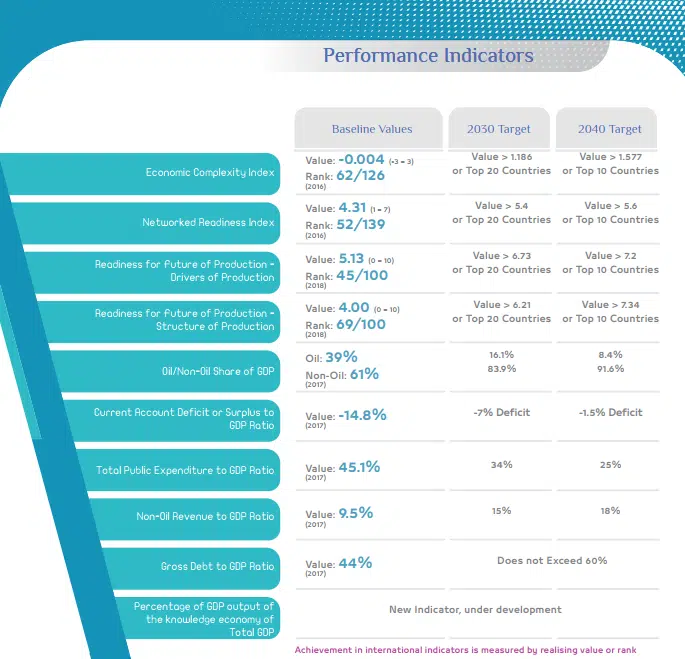
Economic complexity index:
- Base value: negative 0.004 (ranked 62 out of 126 countries in 2016)
- 2030 goal: above 1,186 or among the top 20 countries
- 2040 goal: above 1,577 or among the top 10 countries
Network readiness index:
- Base value: 4.31 (ranked 52 out of 139 countries in 2016)
- 2030 goal: above 5.4 or among the top 20 countries
- 2040 goal: above 5.6 or among the top 10 countries
Preparation for the future of production – drivers of production:
- Base value: 5.13 (ranked 45 out of 100 countries in 2018)
- 2030 goal: above 6.73 or among the top 20 countries
- 2040 goal: above 7.2 or among the top 10 countries
Preparation for the future of production – production structure:
- Base value: 4.00 (ranked 69 out of 100 countries in 2018)
- 2030 goal: above 6.21 or among the top 20 countries
- 2040 goal: above 7.34 or among the top 10 countries
The ratio of current account deficit or surplus to GDP:
- Base amount: 14.8% in 2017
- 2030 target: -7% deficit
- 2040 target: -1.5% deficit
The ratio of total public expenditure to GDP:
- Base amount: 45.1% in 2017
- 2030 target: 34%
- Goal 2040: 25%
The ratio of non-oil income to GDP:
- Base amount: 9.5% in 2017
- 2030 target: 15%
- Goal 2040: 18%
The ratio of gross debt to GDP:
- Baseline: 44% in 2017
- 2030 and 2040 goal: should not exceed 60%
The percentage of gross domestic product of the knowledge-based economy from the total gross domestic product:
This is a new index that is being developed.
Oil/non-oil share of GDP:
- Base amount: oil 39%, non-oil 61% in 2017
- 2030 goal: oil 16.1%, non-oil 83.9%
- 2040 goal: oil 8.4%, non-oil 91.6%
These indicators show that Oman intends to:
Oman’s efforts to modernize its economy include diversifying its economy, reducing dependence on oil, increasing economic complexity, and improving financial sustainability. The focus on preparing for the future of manufacturing and the knowledge-based economy also reflects Oman’s efforts to modernize its economy.
Labor market and employment
This index focuses on creating a dynamic and attractive labor market for talent. Its goals include developing a skilled and productive workforce, creating a recruitment and promotion system based on efficiency and productivity, and attracting talent and a qualified workforce.
Goals
- Labor market with a skilled and productive workforce and a positive work culture
- Recruitment, qualification, promotion, and incentives system based on efficiency and productivity
- Laws and regulations regulating the labor market based on professional standards and a dynamic work environment
- An attractive labor market for talent and skilled labor with transparent and standard employment policies
Numerical and comparative indicators
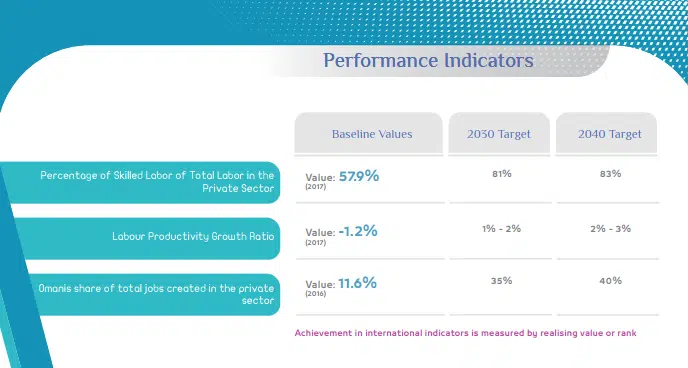
The percentage of skilled labor from the total labor force in the private sector:
- Baseline: 57.9% in 2017
- 2030 target: 81%
- 2040 target: 83%
Labor productivity growth ratio:
- Baseline: minus 1.2% in 2017
- 2030 target: 1% to 2%
- 2040 target: 2% to 3%
The share of Omanis in the total jobs created in the private sector:
- Baseline: 11.6% in 2016
- 2030 target: 35%
- Goal 2040: 40%
These indicators show that Oman intends to:
- Significantly increase the labor force’s skills to increase the share of the skilled labor force from about 58% to 83% by 2040.
- Improve labor productivity to turn current negative growth into positive growth of 2% to 3% by 2040.
- To significantly increase the employment of Omani citizens in the private sector, to increase their share from about 12% to 40% by 2040.
These indicators show that Oman intends to:
- Improving workforce skills
- Increasing economic productivity
- Reducing dependence on foreign labor
- Growing participation for Omani citizens in the private sector
These strategies are part of Oman’s broader effort to diversify its economy, increase competitiveness, and create sustainable employment opportunities for its growing population.
The private sector, investment, and international cooperation
This index seeks to empower the private sector and attract investment. Its goals include creating a competitive business environment, strengthening public-private partnerships, and developing flexible financing models.
Goals
- Competitive business environment attracting investment
- Effective public-private partnership to improve production efficiency
- Various imports and exports in terms of goods and geographical origin
- Unique economic identity integrated with global production and service supply chains
- Flexible and facilitated financing models in line with global developments
- Robust and competitive private sector leading the economy
Numerical and comparative indicators
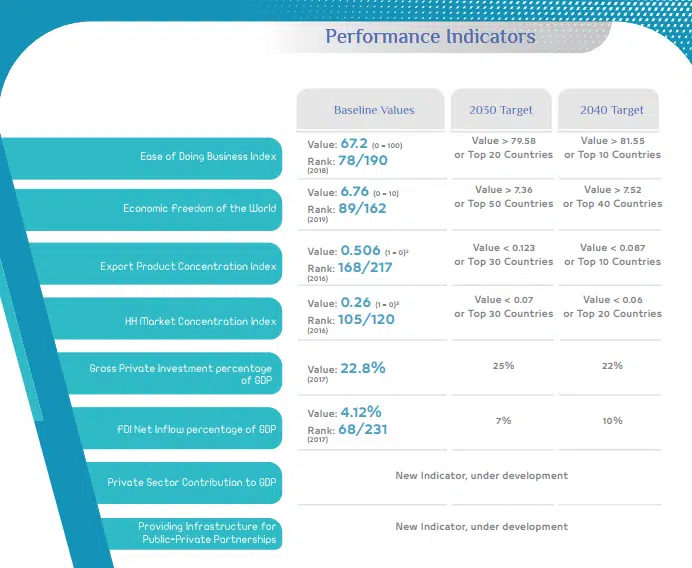
Ease of doing business index:
- Base value: 67.2 (ranked 78 out of 190 countries in 2018)
- 2030 goal: above 79.58 or among the top 20 countries
- 2040 goal: above 81.55 or among the top 10 countries
Concentration index of export products:
- Base value: 0.506 (ranked 168 out of 217 countries in 2016)
- 2030 goal: less than 0.123 or among the top 30 countries
- 2040 goal: less than 0.087 or among the top 10 countries
Economic freedom of the world:
- Base value: 6.76 (ranked 89 out of 162 countries in 2019)
- 2030 goal: above 7.36 or among the top 50 countries
- 2040 goal: above 7.52 or among the top 40 countries
HH market concentration index:
- Base value: 0.26 (ranked 105 out of 120 countries in 2016)
- 2030 goal: less than 0.07 or among the top 30 countries
- 2040 goal: less than 0.06 or among the top 20 countries
Percentage of gross private investment from GDP:
- Baseline: 22.8% in 2017
- 2030 target: 25%
- Goal 2040: 22%
The net flow of foreign direct investment as a percentage of GDP:
- Base value: 4.12% (ranked 68 out of 231 countries in 2017)
- 2030 target: 7%
- 2040 target: 10%
The share of the private sector in GDP:
This is a new index that is being developed.
Providing infrastructure for public-private partnerships:
This is a new index that is being developed.
These indicators show that Oman intends to :
- Improve the business environment significantly.
- Increase the diversity of exports.
- Increase economic freedom.
- Reduce market concentration and increase competition.
- Increase private and foreign investment.
- Expand the role of the private sector in the economy.
- Strengthen public-private partnerships.
These goals reflect Oman’s efforts to create an open, diverse, and competitive economy with a more vital role for the private sector and foreign investment.
Development of provinces and sustainable cities
This index focuses on the balanced and sustainable development of different country regions. Its goals include the balanced development of provinces, the creation of intelligent and sustainable cities, and the strengthening of transportation infrastructure.
Goals
- Balanced and fair development to strengthen the competitive and relative advantages of provinces and urban areas
- Urban and rural areas and cultural and natural heritage with high resilience
- Bright, sustainable, and vibrant cities with dynamic architecture
- Various and accessible means of transportation, integrated with targeted urban planning
- Empowered communities can determine their socio-economic and environmental priorities
- Efficient settlement hierarchy to guide sustainable urban development
Numerical and comparative indicators
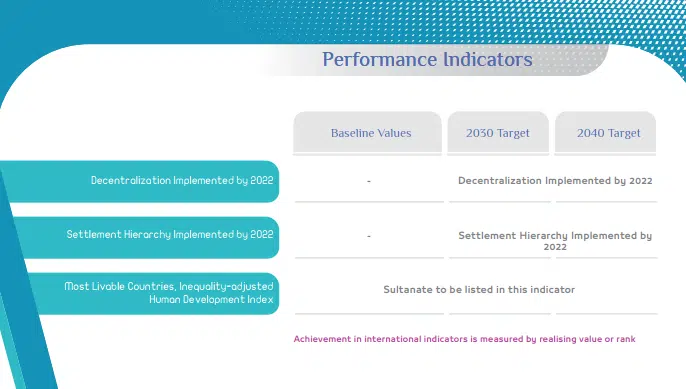
Implementation of decentralization until 2022:
- This is a qualitative goal that must be achieved by 2022.
- 2030 and 2040 goals: Decentralization has been implemented.
Implementation of the settlement hierarchy until 2022:
- This is also a qualitative goal that must be achieved by 2022.
- Goal 2030 and 2040: The settlement hierarchy has been implemented.
In most livable countries, the human development index is adjusted by inequality:
- This is a new index in which Oman plans to be listed.
- Goal 2030 and 2040: Oman is listed in this index.
These indicators show that Oman intends to:
- Implement a more decentralized management system, possibly to give provinces and cities more authority to manage their development.
- Create a hierarchical settlement development system that will likely create a rational and sustainable pattern for urban and rural growth.
- Improve the quality of life across the country so that Oman is recognized as one of the most livable countries, considering human development and equality.
These goals reflect Oman’s efforts to create balanced and sustainable development, improve local governance, and increase the quality of life in all regions. The absence of more accurate quantitative indicators can indicate the complexity of these goals and the need for further development of measurement criteria in this field.
Environment and natural resources
This index seeks to protect the environment and sustainable use of natural resources. Its goals include balancing environmental, economic, and social needs, developing renewable energy, and ensuring food and water security.
Goals
- An environment that ensures a balance between environmental, economic, and social needs
- Renewable energy, diverse energy sources, and optimal consumption to ensure energy security
- A green and circular economy that meets national needs
- Environmental awareness, along with the effective implementation of sustainable production and consumption laws
- Environmental ecosystems with high quality and free from pollution
- Food and water security through renewable resources and advanced technologies
- Sustainable use and investment in natural resources and wealth
Numerical and comparative indicators
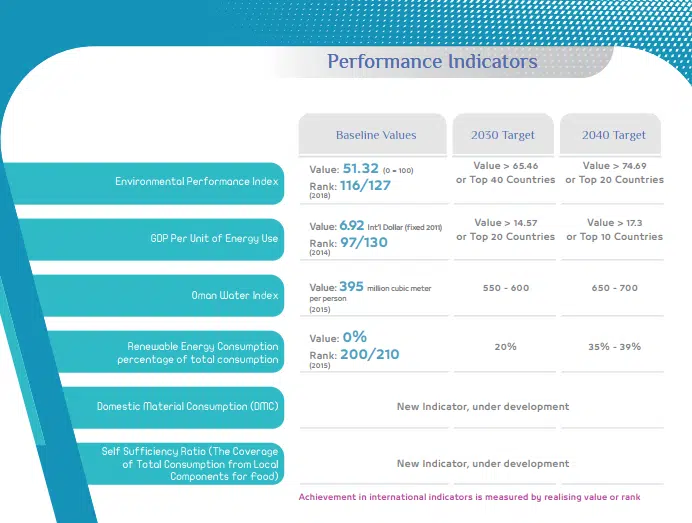
Environmental performance index:
- Base value: 51.32 (ranked 116 out of 127 countries in 2018)
- 2030 goal: above 65.46 or among the top 40 countries
- 2040 goal: above 74.69 or among the top 20 countries
The percentage of renewable energy consumption from the total consumption:
- Base value: 0% (ranked 200 out of 210 countries in 2015)
- 2030 goal: above 14.57% or among the top 20 countries
- 2040 goal: above 17.3% or among the top 10 countries
Internal material consumption (DMC):
- This is a new index that is being developed.
- Self-sufficiency ratio (covering the total consumption of local components for food):
- This is a new index that is being developed.
GDP per unit of energy consumption:
- Base amount: $6.92 international (fixed 2011) (ranked 97th out of 130 countries in 2014)
- 2030 goal: 550-600
- 2040 target: 650-700
Oman Water Index:
- Base amount: 395 million cubic meters per person (2015)
- 2030 target: 20%
- 2040 target: 35% to 39%
These indicators show that Oman intends to :
- Significantly improve its environmental performance.
- Increase the use of renewable energy.
- Improve energy efficiency (increasing GDP per unit of energy consumption).
- Improve water resources management.
- Move towards more sustainable consumption of materials.
- Improve food security through increased local production.
These goals reflect Oman’s commitment to sustainable development, environmental protection, and more efficient use of natural resources. A particular focus on renewable energy and water management shows that Oman sees these as critical challenges for its future.
Legislative, judicial, and regulatory system
This index focuses on improving the legislative, judicial, and regulatory systems. Its goals include creating a participatory legislative system, an independent and efficient judicial system, and an effective and transparent regulatory system.
Goals
- Flexible laws and an independent legislature with full powers
- Practical and independent monitoring system based on transparency and information disclosure
- A society with legal education and active participation in legislative and regulatory processes
- Expert, qualified, and reliable national talents in legislative, judicial, and regulatory fields
- Fast, impartial, and competent judicial system using futuristic technologies
- Effective alternative dispute resolution methods
Numerical and comparative indicators
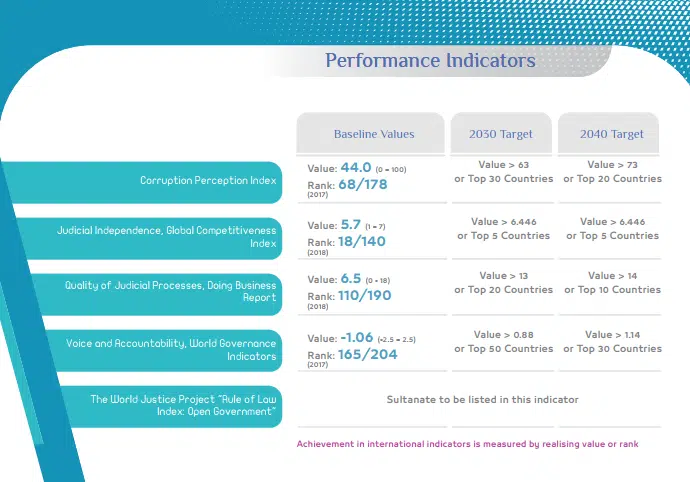
Corruption Perception Index:
- Base value: 44.0 (ranked 68 out of 178 countries in 2017)
- 2030 goal: above 63 or among the top 30 countries
- 2040 goal: above 73 or among the top 20 countries
Judicial independence, global competitiveness index:
- Base value: 5.7 (ranked 18 out of 140 countries in 2018)
- 2030 and 2040 goal: above 6,446 or among the top 5 countries
Quality of judicial processes, reporting of doing business:
- Base value: 6.5 (ranked 110 out of 190 countries in 2018)
- 2030 goal: above 13 or among the top 20 countries
- 2040 goal: above 14 or among the top 10 countries
Voice and accountability, global governance indicators:
- Base value: 1.06 (ranked 165 out of 204 countries in 2017)
- 2030 goal: above 0.88 or among the top 50 countries
- 2040 goal: above 1.14 or among the top 30 countries
Global Justice Project “Rule of Law Index: Open Government”:
This is a new index in which Oman plans to be listed.
These indicators show that Oman intends to :
- Reduce corruption significantly and increase transparency.
- To further strengthen judicial independence, which is currently relatively high.
- Improve the quality of judicial processes significantly.
- Increase voice and responsiveness significantly, which indicates an effort to increase citizen participation and government accountability.
Governance of administrative institutions, resources, and government projects
This index seeks to improve governance and management in the public sector. Its goals include providing high-quality government services, creating transparency and disclosure of institutional information, and effectively managing government resources and projects.
Goals
- Government services with high quality and performance
- Transparent and competitive hiring standards for leadership positions in the public sector
- Transparency and disclosure of institutional information to guarantee the right of access to information
- Balanced and long-term partnership between stakeholders to ensure effective institutional performance
- Solid and reliable government decisions
- Comprehensive monitoring system to protect national assets
- A forward-looking public sector with effective structuring in planning, regulation, monitoring, and evaluation
- Effective governance of resources and projects
Numerical and comparative indicators
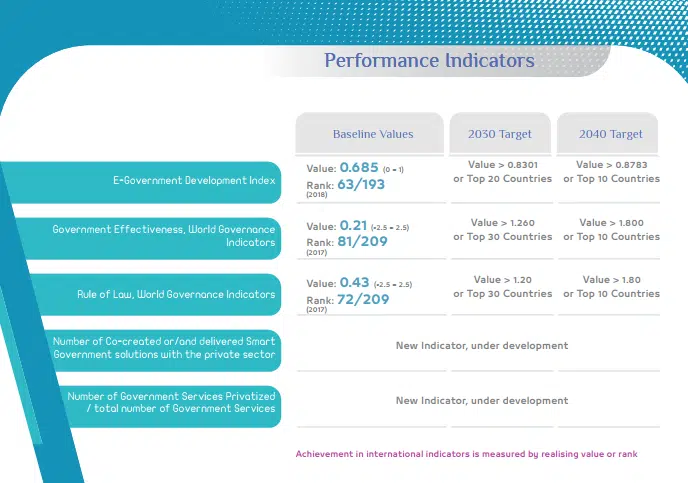
Electronic Government Development Index:
- Base value: 0.685 (ranked 63 out of 193 countries in 2018)
- 2030 goal: above 0.8301 or among the top 20 countries
- 2040 target: above 0.8783 or among the top 10 countries
Government effectiveness, global governance indicators:
- Base value: 0.21 (ranked 81 out of 209 countries in 2017)
- 2030 goal: above 1.260 or among the top 30 countries
- 2040 goal: above 1,800 or among the top 10 countries
The rule of law, global governance indicators:
- Base value: 0.43 (ranked 72 out of 209 countries in 2017)
- 2030 goal: above 1.20 or among the top 30 countries
- 2040 goal: above 1.80 or among the top 10 countries
Number of intelligent government solutions created and provided by the private sector:
This is a new index that is being developed.
Number of privatized government services / total number of government services:
This is a new index that is being developed.
These indicators show that Oman intends to :
- Significantly develop e-government, aiming to be among the top 10 countries in the world by 2040.
- To significantly increase the government’s effectiveness, improve from the 81st rank to the top 10 countries in the world.
- Strengthen the rule of law to reach the top 10 countries in the world.
- Increase cooperation with the private sector in providing intelligent government services.
- Consider the privatization of some government services.
These goals show Oman’s commitment to:
- Modernizing the government and government services
- Improving the efficiency and effectiveness of government institutions
- Strengthen the rule of law
- Increasing the participation of the private sector in providing public services
- Improving the quality of governance in general
These efforts can improve the quality of public services, increase government efficiency, reduce bureaucracy, and create a more favorable environment for business and investment.