

Buying Property in Oman's ITCs: Locations, Ownership and Legal Checks
Buying property in Oman ITC developments is one of the established routes through which foreign nationals can acquire residential real estate in the Sultanate. Under Oman's Integrated Tourism Complexes ownership framework, non-Omanis may purchase land or completed units within licensed developments, subject to the applicable regulations and any restrictions on the specific project. The critical step is verifying that the particular property is eligible for foreign ownership before signing a contract or transferring a deposit.
Al Mouj in Muscat, Jebel Sifah near Muscat and Hawana Salalah in Dhofar are among the established developments worth comparing. Each offers a different location and lifestyle proposition. However, a development's reputation, tourism facilities or marketing description does not automatically establish that every unit can be transferred to a foreign buyer.
At a glance
- Foreign nationals can own eligible properties within licensed Integrated Tourism Complexes (ITCs) in Oman.
- Al Mouj, Jebel Sifah and Hawana Salalah are important developments to consider when comparing locations.
- Freehold ownership and usufruct are different legal rights, with different implications for duration and transfer.
- The project's authorization and the individual unit's eligibility must be checked separately.
- Property registration involves government procedures and fees, including charges linked to the property's value.
- Buying a property does not automatically grant Omani residency.
Understanding Oman's ITC property ownership framework
An Integrated Tourism Complex is a designated development combining tourism, residential, leisure and supporting facilities under an approved development framework. ITCs are particularly relevant to international buyers because Oman provides a specific legal route for foreign ownership within eligible developments.
The framework originates from Royal Decree 12/2006, which established the property ownership system for Integrated Tourism Complexes. Royal Decree 65/2007 amended the framework, expressly allowing Omani and non-Omani individuals and legal entities to acquire land or completed units in licensed ITCs for residential or investment purposes, subject to the applicable conditions. The original ITC ownership decree and its 2007 amendment provide the legal foundation.
There is an important qualification: the government retains the authority to restrict ownership in a particular complex to Omani nationals. Consequently, buyers should not assume that every tourism development, residential building or advertised property is automatically available to foreign purchasers.
The Ministry of Heritage and Tourism is relevant to the development and licensing framework, while the Ministry of Housing and Urban Planning administers property ownership registration and related services. Buyers should establish both the project's regulatory status and the property's registration position before committing funds.
Which Omani ITC locations should foreign buyers compare?
The right location depends on whether the property is intended for permanent residence, occasional holidays or rental investment. Muscat developments offer a different proposition from resort properties in Dhofar, so comparing them solely by advertised prices can lead to poor decisions.
Al Mouj, Muscat: Coastal living with urban access
Al Mouj is an established coastal residential and tourism development in Muscat. Its marina, residential buildings, leisure facilities and waterfront environment make it a relevant option for buyers who want a property in the capital while retaining access to coastal amenities.
For an international purchaser, the principal considerations include the building's exact location, access to everyday services, property condition and the legal status of the individual unit. An apartment overlooking the marina and a unit in another part of the development may have very different market characteristics.
Before comparing apartments, obtain the title information, confirm the seller's legal authority and establish whether the unit can be registered in your name as a non-Omani. Also examine service charges, maintenance responsibilities and any restrictions on leasing or use of shared facilities.
Jebel Sifah: A resort-oriented coastal setting
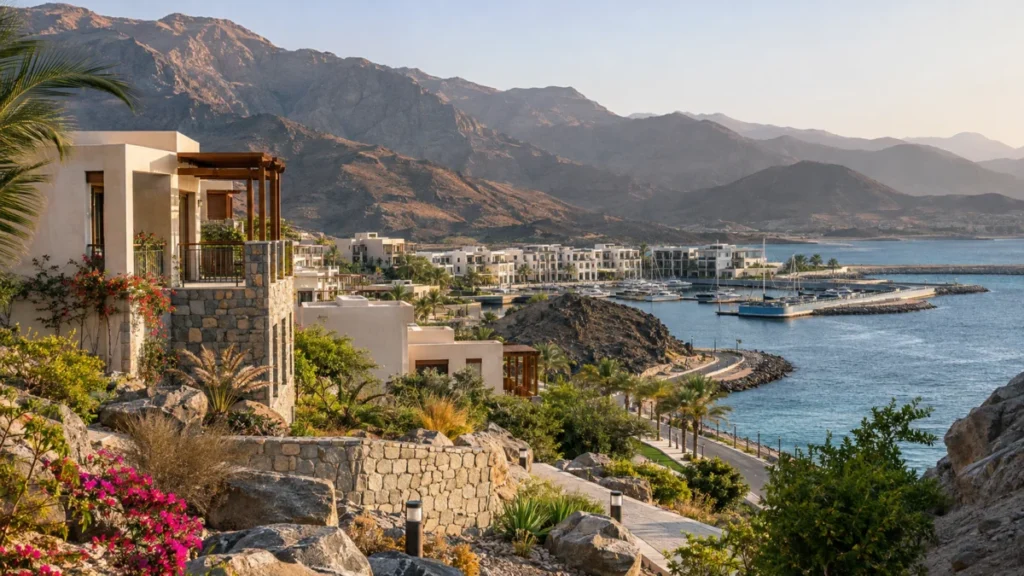
Jebel Sifah, located along the coast near Muscat, offers a different environment from a conventional city apartment. Its coastal setting and surrounding mountain scenery make it worth considering for buyers interested in holiday accommodation or a quieter residential environment.
Location within the development matters. Distance from the marina, leisure facilities and other services can influence convenience, personal use and potential rental demand. Buyers should also examine road access, building management arrangements and the annual cost of maintaining the property.
For investment purposes, calculate potential net rental income after management charges, maintenance and periods when the unit may remain vacant. Resort facilities alone do not guarantee occupancy or a particular investment return.
Hawana Salalah: Property in Oman's southern region
Hawana Salalah, in Dhofar, is an established tourism destination in southern Oman. Its coastal environment makes it relevant to buyers who prefer a resort-oriented property outside the Muscat metropolitan area.
When evaluating a unit, examine its distance from the waterfront, access to facilities, building management and the practical arrangements for maintaining the property when you are away. Buyers planning to rent their units should assess demand throughout the year rather than relying on peak tourism periods alone.
As with other ITC developments, the specific unit's ownership status must be established. The development's tourism identity is not a substitute for a valid ownership document and an eligible registration route.
Other developments and emerging opportunities
Other developments associated with Oman's tourism investment programme include Barr Al Jissah, Yiti, Blue City, Al Sharq, Al Nakheel Resort and projects around Ras Al Hadd. These developments differ in location, development stage and intended use.
A project appearing in a tourism development programme should not be treated as proof that completed units are currently available for foreign ownership. Buyers should obtain the relevant development authorization and verify the specific unit's legal position before entering into a transaction.
One notable development announcement concerns a new ITC in Al Qurum, Muscat. On 3 March 2026, an agreement was announced between the Ministry of Heritage and Tourism and Sourah Al Qurum Real Estate for a development covering approximately 165,000 square metres, with an estimated investment of OMR 230 million.
The proposed development includes residential units, hotels, retail and leisure facilities, with implementation planned in stages over 15 years. The announcement identifies freehold residential ownership as part of the project concept. Buyers should nevertheless distinguish a development agreement from the actual release and registration of units. The official Al Qurum development announcement outlines the project.
Comparing ITC developments before choosing a property
Location is only one part of the comparison. A practical assessment should include the intended use, accessibility, property type, facilities, ownership documentation and ongoing costs.
| Development | Location | Key consideration | Buyer due diligence |
|---|---|---|---|
| Al Mouj | Muscat | Coastal residential environment and urban services | Building location, title and service charges |
| Jebel Sifah | Coastal area near Muscat | Resort setting and natural surroundings | Access, facilities and maintenance costs |
| Hawana Salalah | Salalah, Dhofar | Southern coastal tourism destination | Unit location and property management |
| Barr Al Jissah | Muscat | Established coastal tourism area | Project and unit ownership eligibility |
| Yiti | Muscat | Large-scale tourism and urban development | Development stage and sales authorization |
| Blue City | Oman | Tourism-oriented development project | Current project status and title arrangements |
| Al Qurum | Muscat | New phased tourism development | Unit release and ownership registration |
This comparison is a starting point, not a ranking of investment returns. Two properties in the same development can differ substantially in condition, position, ownership rights, maintenance costs and resale prospects.
Freehold versus usufruct: What are you actually buying?
One of the most important decisions in buying property in Oman ITC developments is identifying the legal right being transferred. Freehold ownership and usufruct are not interchangeable, and the contract must accurately reflect the arrangement.
Freehold ownership
Freehold gives the purchaser registered ownership of the property, subject to applicable laws and restrictions. The buyer should receive the appropriate ownership documentation through the official registration process.
Do not rely solely on a sales brochure or a developer's description of a property as freehold. Check the legal title, confirm the foreign buyer's eligibility and ensure that the final registration records the intended ownership rights.
Usufruct rights
Usufruct grants the holder the right to use and benefit from a property for a defined period under a registered agreement. It does not provide the same legal position as unrestricted freehold ownership.
Oman's official service for transferring usufruct rights provides for a contractual duration ranging from one year to 99 years. Transfer requires the relevant documentation and the owner's consent, subject to the applicable conditions.
The official usufruct registration service and usufruct transfer service explain the relevant administrative procedures.
Before accepting usufruct, check the remaining term, transfer conditions, permitted use, maintenance obligations and the position when the agreement expires. These details can materially affect the property's value and suitability for long-term investment.
How to buy property in an Omani ITC: Step by step
A sound transaction begins with project verification and ends with official registration. Signing a reservation form or paying a deposit does not, by itself, establish registered ownership.
- Define your purchase objective. Decide whether you need a permanent residence, holiday home or rental investment. This will determine which location and property type deserve priority.
- Shortlist developments and units. Compare location, size, building condition, facilities, asking price and ongoing charges. Obtain the exact unit number and registration details.
- Check the development's authorization. Establish that the project falls within the applicable ITC legal framework and has the necessary approval.
- Verify foreign ownership eligibility. Obtain documentation showing that the specific property can be transferred to a non-Omani buyer. Do not rely only on the development's name.
- Inspect the title and legal status. Check the ownership document, cadastral information, mortgage status, attachments and any legal restrictions affecting the property.
- Review the sale agreement. Confirm the price, payment schedule, completion obligations, delivery arrangements, service charges and transfer conditions. For usufruct, examine the contractual duration and rights carefully.
- Prepare the registration application. The buyer and seller must meet the Ministry of Housing and Urban Planning's registration and electronic identity requirements.
- Complete registration and obtain the document. Follow the official process and compare the final ownership document with the agreed property specifications.
Foreign buyers can begin by consulting the government's property ownership service for tourist complexes. For a purchase based on a sale contract, the title deed issuance service is also relevant.
Documents and legal requirements for foreign purchasers
Documentation depends on the buyer's legal status and the structure of the transaction. Individual buyers, joint purchasers and companies may have different requirements.
- Valid identification documents for the buyer and seller.
- Residence or identification documents where required for the buyer's status.
- The existing property title and relevant registration information.
- The sale agreement or registered usufruct agreement.
- Cadastral plans or updated property drawings where required.
- Electronic registration and identity verification through the relevant government platform.
- Company registration and authorized signatory documents when purchasing through a legal entity.
- Consent from other co-owners where joint ownership requires approval for transfer.
- Mortgagee or secured creditor consent where a mortgage or security interest restricts transfer.
- Developer's no-objection documentation in transactions where the relevant government service requires it.
The property must not be subject to a legal restriction preventing transfer. A mortgaged property may require the secured creditor's consent, while a jointly owned property may require the other owner's approval. The cadastral information and title details should also match the property being purchased.
Government registration fees and processing times
Buyers should budget for official registration charges separately from the purchase price, developer charges and ongoing property expenses. The government's ITC ownership service lists the following fees:
| Government service charge | Amount |
|---|---|
| Real estate platform application registration | OMR 5 |
| Application form | OMR 25 |
| Title deed issuance | OMR 10 |
| Contract fee | OMR 2 |
| Contract-related charge listed by the service | 3% of property value |
The 3% charge should be included in the transaction cost calculation, with its applicable basis checked against the actual transaction. These are government service charges, not the developer's sale price or annual service fees. Refer to the official ITC ownership service when preparing the application.
Usufruct transactions follow a separate registration route. The official usufruct transfer service lists a registration charge of 3% of the market value of the usufruct right and an OMR 10 contract registration visa fee. These charges should not be automatically applied to a freehold purchase.
How long does registration take?
| Service | Published processing time |
|---|---|
| Property ownership in a tourist complex | 2 days |
| Usufruct transfer | 1 day |
| Establishment licence for an ITC | 6 months |
These are administrative service timelines, not guaranteed end-to-end property purchase periods. Preparing documents, resolving title restrictions, obtaining consent and completing the sale agreement can require additional time.
Common mistakes foreign property buyers should avoid
Most avoidable problems arise when buyers treat marketing information as a substitute for legal verification. The following checks should be completed before funds are committed.
Assuming every tourism development permits foreign ownership
Foreign ownership is governed by the ITC legal framework and applicable restrictions. Verify the project's status and the individual unit's eligibility rather than relying on its tourism branding.
Confusing freehold with usufruct
A long-term right to use a property is not automatically freehold ownership. Read the registered agreement and identify the duration, transfer rights and obligations.
Paying a deposit before reviewing the title
Establish that the seller has legal authority to transfer the property and check for mortgages, attachments or other restrictions. Any required consent should be addressed before completion.
Ignoring service and maintenance charges
Annual service charges, repairs and shared-facility costs affect the true cost of ownership. Obtain written details and include them in your financial assessment.
Relying on guaranteed rental income
Tourism facilities do not guarantee occupancy or rental returns. Evaluate comparable rental properties, management costs, seasonal demand and periods of vacancy.
Assuming property ownership automatically provides residency
Property ownership and immigration status are separate matters. If residency is part of your investment objective, assess the relevant immigration route independently before purchasing.
Frequently asked questions about buying property in Oman ITC developments
These answers cover the main ownership, location and registration considerations for international purchasers.
Choosing the right ITC property with Connsect
A suitable property should meet three tests: it must fit your intended use, make financial sense after ongoing costs, and be legally transferable to you. A strong location cannot compensate for an unsuitable ownership arrangement, just as a valid title does not automatically make a property a sound investment.
Connsect assists international buyers with property opportunities in Oman, including the initial assessment of locations, development options and purchase requirements. Property opportunities start from approximately OMR 40,000, depending on the location, property type, size and specific offer. This is an entry-level price indication rather than a fixed price for any particular ITC.
Before proceeding, prepare the development name, unit details, intended use and approximate budget. The assessment should cover the ownership type, registration eligibility, title documentation, seller's authority, service charges and contractual transfer conditions.
You can request a free initial consultation with Connsect to discuss your property requirements and identify the appropriate next steps.
For an international purchaser, the most important decision is not simply which development looks attractive. It is whether the specific property can be legally registered under the intended ownership arrangement, with its costs and obligations clearly understood before the transaction is completed.





Comments & experiences
Share a useful experience or ask a relevant question.