

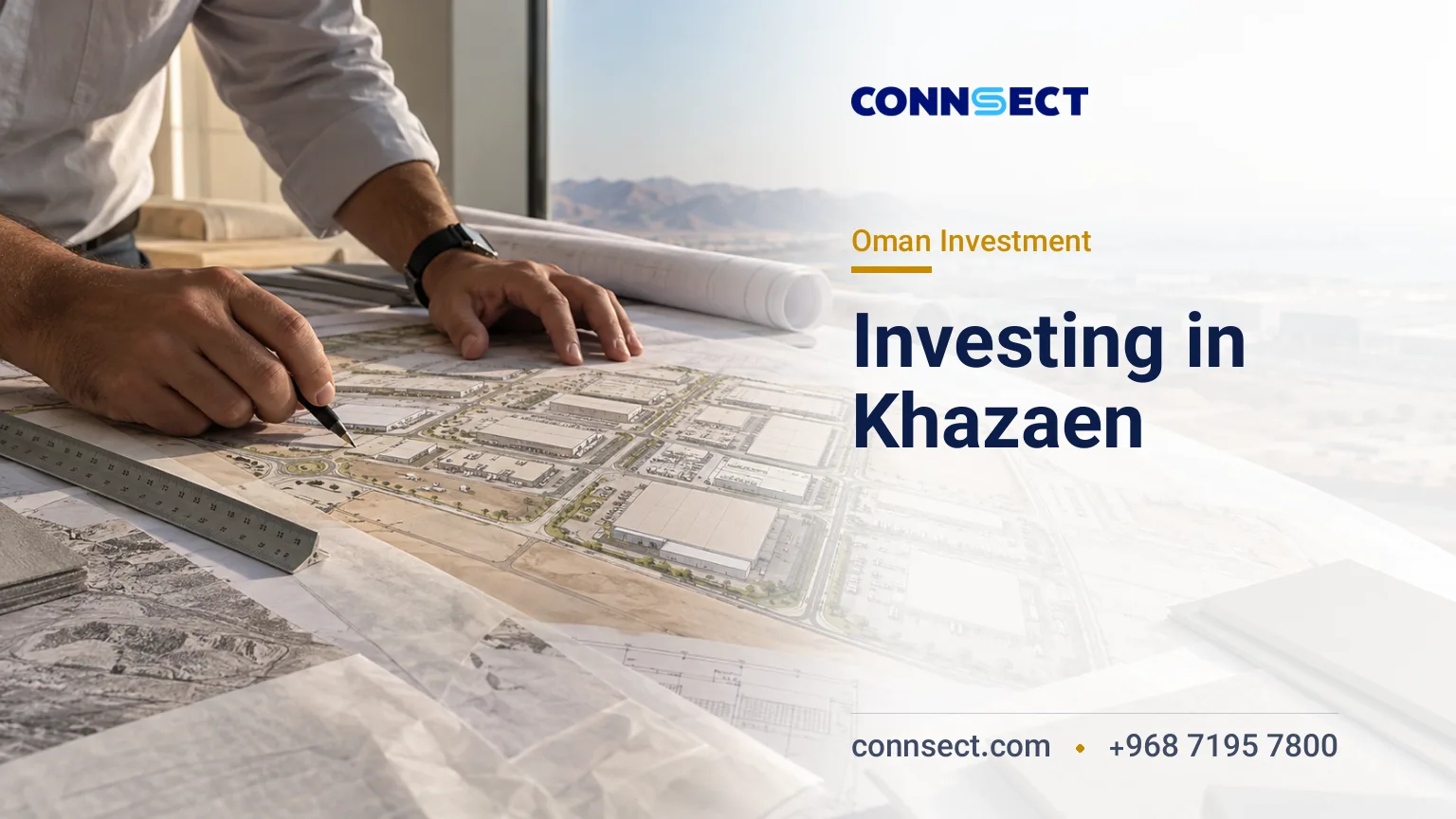
Investing in Khazaen Economic City makes the most sense for businesses that need industrial land, warehouse space, distribution facilities or access to Oman's transport network. Located in Barka, South Al Batinah Governorate, Khazaen brings together planned industrial, logistics, commercial and supporting-service activities. Before committing capital, investors should establish which part of the development suits their business, how land allocation works, which licences apply and what the full operating costs will be.
At a glance
- Location: Barka, South Al Batinah Governorate, along the Muscat–Al Batinah highway corridor.
- Target sectors: Warehousing, distribution, light and medium industry, manufacturing, packaging, assembly and business services.
- Regulatory authority: The Public Authority for Special Economic Zones and Free Zones (OPAZ) oversees the relevant economic-zone framework.
- Land application: Submit an investment application, undergo evaluation, review the proposed allocation and proceed to the relevant lease or usufruct agreement.
- Application assessment: Khazaen's published process gives an indicative assessment period of five working days, separate from the time needed for allocation and licensing.
- Company setup: Connsect offers mainland Omani limited liability company registration for OMR 275, with a stated processing time of 7–10 working days.
Where is Khazaen Economic City?
Khazaen Economic City is in Barka, South Al Batinah Governorate, on the Muscat–Al Batinah highway corridor. Its location is relevant to companies that need to coordinate storage, manufacturing, road freight and distribution between their facilities and customers.
According to the developer's published location information, the site is approximately 50 kilometres from Muscat International Airport and 156 kilometres from Sohar Port. These distances provide a starting point for logistics planning, but actual transit times depend on routing, traffic, cargo requirements and customs procedures.
The development is intended to combine industrial and logistics facilities with commercial and supporting services. It should not be treated as a single, uniform industrial estate: the permitted uses, available facilities and contractual conditions can differ between locations. Review the official location information and assess the specific plot or unit offered for your project.
Infrastructure and business opportunities
Khazaen's investment proposition centres on industrial activity, storage, distribution and services that support businesses operating in Oman and regional supply chains. The appropriate opportunity depends on the physical infrastructure your operation needs and whether the relevant facility is available on workable commercial terms.
Warehousing, distribution and cold storage
The developer identifies commercial warehouses, food storage, cold-storage facilities, building-material storage, distribution and cargo-handling activities among the opportunities associated with the city. These uses may suit importers, wholesalers, distributors and businesses that need a regional inventory base.
For temperature-sensitive products, confirm the facility's operating specifications, temperature-control capability, loading arrangements and service costs before signing. A general warehouse designation does not establish that a unit meets the requirements of food, pharmaceutical or other regulated goods.
Manufacturing and industrial operations
Published investment categories include light and medium industry, manufacturing, packaging, assembly, repair and maintenance. A suitable industrial plot must accommodate the production process, equipment, utilities, vehicle access and any planned expansion.
Prepare a concise technical description before submitting an application. Explain the production activity, estimated space requirement, inbound materials, outbound products and infrastructure needs. This helps the developer assess the project against the proposed site's intended use.
Commercial and support services
Khazaen also promotes opportunities involving offices, information technology, financial and legal services, data centres, retail, accommodation and other commercial facilities. These businesses may serve manufacturers, transport operators, warehouse tenants and employees working within the development.
Supporting solutions promoted by the developer include worker accommodation, road-transport services and prefabricated industrial or warehouse units. Treat each offering as a specific commercial proposition: obtain written details of availability, technical specifications, delivery arrangements and recurring charges.
Who should consider investing in Khazaen?
Khazaen is most relevant to businesses whose operations depend on physical space, industrial infrastructure, inventory management or freight distribution. Investors should compare the proposed site with their actual operating requirements rather than selecting a location solely because it is marketed as an economic city.
- Importers and distributors requiring storage and road access.
- Supply-chain operators looking for commercial or temperature-controlled warehousing.
- Manufacturers, packaging companies and assembly operations.
- Freight, transport, cargo-handling and industrial-support businesses.
- Professional and technology service providers serving industrial and logistics tenants.
- Investors seeking land or a ready-built facility for a defined operating project.
Businesses that mainly need a small office serving customers in central Muscat should compare Khazaen with other locations, taking staff commuting, customer access and total occupancy costs into account. Similarly, locating a project in the development does not automatically replace the sector-specific approvals required for regulated activities.
Free-zone status, ownership and incentives
The legal status of the proposed location matters because a free-zone plot and another part of Khazaen may not carry identical regulatory treatment. Investors should establish the exact zone, permitted activity and applicable conditions before relying on a tax, customs or ownership benefit.
Royal Decree 44/2023 established Khazaen Economic City and its governing framework, including two free zones within the development. OPAZ is the relevant supervisory authority, while Khazaen Economic City is the developer. Investors can consult the published text of Royal Decree 44/2023 for the legal framework.
OPAZ describes incentives across the zones under its remit, including 100% foreign ownership, repatriation of capital and profits, customs exemptions in qualifying circumstances and tax exemptions that may extend to 30 years under the applicable framework. These are not automatic guarantees for every company in every part of Khazaen. Confirm the precise location, eligibility conditions, activity classification and applicable rules before incorporating the benefits into a financial model.
How to apply for investment and land allocation
The practical starting point is a defined business proposal submitted through Khazaen's investment application process. The developer evaluates the proposal, considers the investor's space and infrastructure requirements, and proceeds with a suitable allocation and contractual process where the application advances.
- Define the project. Identify the activity, approximate floor or land area, utility requirements, equipment, vehicle movements and intended implementation schedule. Distinguish between a requirement for vacant land and a requirement for a ready-built warehouse or industrial unit.
- Prepare the application. Complete the investment application with consistent company details, contact information and a clear description of the proposed operation. Include the commercial registration number if the company is already registered.
- Allow for assessment. Khazaen publishes an assessment period of five working days for an investment application. This is an assessment milestone, not a guaranteed deadline for land handover, company registration or all operating licences.
- Review the proposed site and commercial terms. Check the permitted use, plot size, access, utilities, lease amount, service charges and handover conditions. Ask for written clarification where the proposal does not match the project's technical requirements.
- Accept the allocation and execute the agreement. Follow the developer's acceptance process and review the relevant lease or usufruct agreement. Confirm payment obligations, duration, permitted use, delivery arrangements and responsibilities before signing.
- Complete registration and licensing. Obtain the commercial registration and the investment or sector-specific licences required for the selected company structure and activity. Land allocation alone is not permission to undertake every industrial or commercial operation.
- Prepare for operations. Coordinate facility handover, equipment installation, staffing and other operational requirements with the applicable permits and contractual deadlines. Set the opening date around actual readiness rather than the initial application assessment period.
Start with the developer's investment application procedure. The information submitted may be used to assess the project and prepare a commercial offer, so the description of your proposed activity should be accurate and specific.
Documents and requirements
Requirements depend on whether you are applying for land, registering a company or obtaining an investment licence. These are separate steps, and a document suitable for one application may not satisfy every requirement for another.
- Applicant identification and valid contact details.
- Company name in Arabic and English and the commercial registration number, where applicable.
- A description of the business activity, project requirements and implementation plan.
- A passport copy for the government investment-licence application, as required by the service.
- A feasibility study for the investment-licence application.
- Evidence of relevant experience where required for the licence application.
- A bank statement covering at least three months, as listed in the government service requirements.
- A lease agreement or evidence relating to the business premises at the relevant licensing stage.
Keep the company name, applicant details and business activity consistent across the application and supporting documents. Before preparing final submissions, obtain the current checklist for your particular project and application stage from the relevant authority or developer.
Costs and timelines
Total investment costs include the land or facility lease, infrastructure and service charges, company formation, licences, equipment and operating expenses. Keep these categories separate when comparing a proposed location with alternative sites.
| Service or stage | Published cost or timing | What it covers |
|---|---|---|
| Khazaen investment application assessment | Five working days | Assessment period published by the developer, not the full project approval process. |
| Connsect mainland LLC registration without client travel | OMR 275; 7–10 working days | Company registration service. This is for mainland registration, not a universal fee for every free-zone or Khazaen structure. |
| Government investment licence | OMR 0.900 | Published fee for the relevant government service. Other company setup, sector licensing and project costs are separate. |
| Connsect two-year investor visa service | OMR 795 | Includes a business plan, municipal licence, visa, medical test and Oman ID card. |
| Connsect one-year investor visa service | OMR 625 | Includes a business plan, municipal licence, visa, medical test and Oman ID card. |
| Investor visa processing through Connsect | 20–30 working days | Published processing timeframe for the investor visa service. |
| Company registration plus two-year investor visa | OMR 1,090 | Connsect package combining company registration and the two-year investor visa service. |
| Company registration plus one-year investor visa | OMR 920 | Connsect package combining company registration and the one-year investor visa service. |
Land rent, warehouse rent and infrastructure charges should be calculated from the commercial offer for the specific property. Request written terms covering payment frequency, service charges, handover and the obligations of both parties.
If you are still deciding on a company structure or the sequence of your applications, Connsect offers a free initial consultation to discuss company registration, investor residency and the steps required to establish an operation in Oman.
Common mistakes to avoid
Investment decisions can become unnecessarily expensive when the location, contractual terms and licensing sequence are treated as secondary details. The following checks help reduce avoidable delays and budgeting errors.
- Assuming all zones have the same incentives: Establish whether the proposed plot is inside a free zone or another part of the development.
- Choosing by area alone: Evaluate road access, loading arrangements, utilities and expansion capacity alongside plot size.
- Treating assessment time as the launch date: The five-working-day assessment period does not replace the time needed for allocation, contracting, registration and licensing.
- Ignoring recurring charges: Include service costs, site preparation, equipment, staffing and other operating expenses in the budget.
- Signing before clarifying obligations: Review the permitted use, lease term, payment schedule, handover conditions and responsibilities before accepting the agreement.
- Assuming a land agreement authorises every activity: Complete the commercial registration and applicable investment or sector-specific licensing steps.
- Budgeting around planned infrastructure: Base the operating plan on facilities available for use when the project starts, and verify the status of any essential service directly.
Frequently asked questions
Your next step
Before applying, define the business activity, company structure, land or warehouse requirement and operating budget. Then compare the proposed site with your technical requirements, licensing obligations, contractual commitments and expected launch schedule.
For guidance on company registration, investor residency and the practical steps involved in establishing a business in Oman, use Connsect's consultation request page. The initial consultation is free and provides an opportunity to discuss the project requirements before proceeding.



Comments & experiences
Share a useful experience or ask a relevant question.