

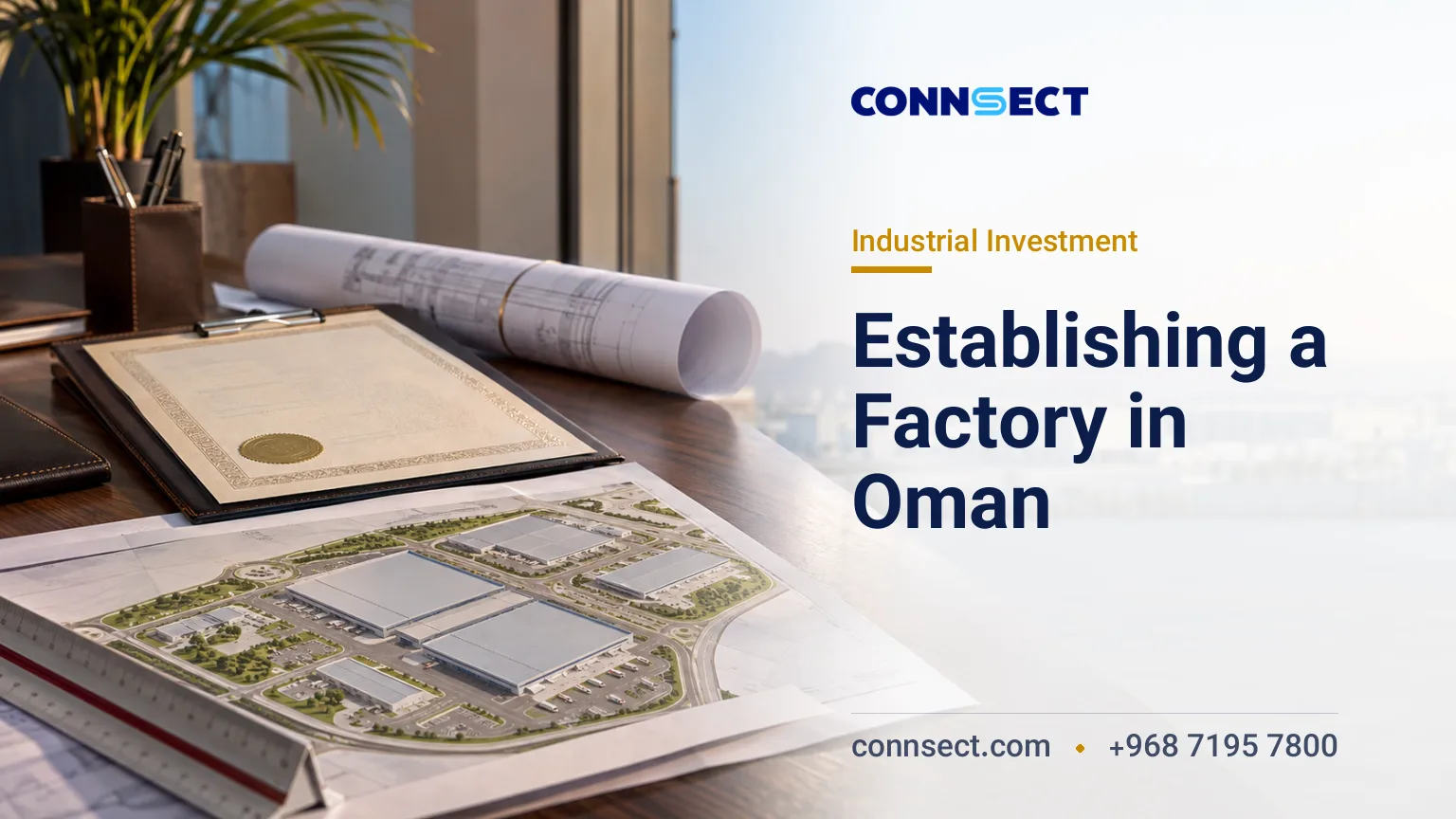
Factory setup in Oman requires more than registering a company and leasing a plot. Investors must coordinate industrial land allocation, commercial registration, investment and industrial licensing, environmental approval, construction requirements and operational clearances before manufacturing can begin. Oman offers established industrial estates managed by Madayn, opportunities for full foreign ownership in industrial cities and long-term land arrangements, making it a practical location to assess for regional manufacturing operations.
Factory setup in Oman at a glance
- Manufacturing companies register through the Oman Business Platform under the Ministry of Commerce, Industry and Investment Promotion (MOCIIP).
- Madayn manages ten industrial cities across Oman, providing industrial plots and supporting infrastructure.
- Foreign investors can access 100% ownership opportunities for industrial activities in Madayn industrial cities, subject to the applicable conditions.
- Industrial licensing, investment licensing and environmental permitting are separate regulatory requirements.
- Published environmental permit fees range from OMR 150 to OMR 900 for the categories covered by the relevant services.
- Before commencing operations, factories must meet applicable building, Civil Defence, insurance and industrial-estate activity requirements.
Is Oman suitable for your manufacturing project?
Oman is worth considering for businesses planning to establish an independent manufacturing operation rather than a small workshop or trading company. Projects involving dedicated production lines, industrial machinery, processing facilities, packaging operations and large-scale manufacturing require a more comprehensive investment and licensing process.
Foreign investors can establish manufacturing businesses in Oman. Madayn identifies 100% foreign ownership as an available advantage for industrial activities in its industrial cities. The appropriate legal structure, registered activities and site conditions must still match the proposed operation.
Oman may be relevant to several investor profiles:
- Existing manufacturers expanding production capacity into the Gulf region.
- International businesses seeking a regional manufacturing or processing base.
- Investors converting raw materials into finished or semi-finished products.
- Companies requiring dedicated industrial infrastructure and long-term land arrangements.
- Entrepreneurs establishing independent production facilities with imported machinery and specialist staff.
The first decision should be the actual manufacturing activity. Assembly, processing, packaging and full-scale manufacturing can involve different technical and regulatory requirements. Defining the production process accurately helps determine the appropriate commercial registration activities, environmental classification and industrial approvals.
Choosing an industrial location in Oman
The location affects land costs, infrastructure access, logistics and environmental permitting. Investors should compare industrial cities and approved investment zones against the factory's operational requirements before committing to a plot.
Madayn industrial cities
Madayn manages ten industrial cities: Sur, Sohar, Raysut, Nizwa, Buraimi, Rusayl, Samail, Ibri, Al Mudhaibi and Mahas. These locations provide options across different parts of Oman, allowing manufacturers to consider proximity to suppliers, customers, ports and transport routes.
Madayn also manages Knowledge Oasis Muscat and Al Mazunah Free Zone. These facilities should not automatically be treated as equivalent to ordinary industrial-city plots because their investment frameworks and operating conditions differ.
For a manufacturer dependent on maritime logistics, proximity to port infrastructure may influence the decision. A factory serving domestic distribution networks may place greater importance on road access, workforce availability and proximity to customers.
The Madayn industrial estates directory provides the starting point for comparing locations and investment arrangements.
Industrial land leases and infrastructure
Madayn's published framework allows industrial land and facility leases of up to 30 years, renewable for a similar period. This arrangement can support projects involving substantial construction, fixed machinery and long-term production planning.
For certain industrial investment arrangements, the published land rental incentive is OMR 1 per square metre annually during the first five years. Investors should assess the applicable conditions and subsequent contractual rates through the project-specific allocation offer rather than treating this figure as a universal price for every industrial plot.
Industrial estates provide infrastructure such as roads, electricity, water and telecommunications. However, the availability of infrastructure does not automatically mean that every plot can accommodate a high-consumption production line. Obtain written information about electrical load, water capacity, connection arrangements and any site restrictions before ordering machinery.
How to establish a factory in Oman: the process
A factory project should follow a coordinated sequence of commercial, technical and regulatory steps. Completing the early decisions correctly reduces the risk of leasing an unsuitable plot, registering the wrong activity or purchasing machinery that cannot be accommodated at the selected site.
- Define the manufacturing project. Identify the product, raw materials, production technology, annual capacity, machinery requirements and target markets. Estimate electricity and water consumption, wastewater, emissions, chemicals and industrial waste. These details influence both site selection and environmental classification.
- Compare industrial locations. Evaluate Madayn industrial cities, approved free zones and other suitable locations. Consider transport access, utilities, suppliers, workforce requirements, expansion capacity and the conditions attached to each investment area.
- Apply for industrial land allocation. Submit the application and supporting documents to the relevant industrial-estate administration. Once allocation is notified, review the proposed plot and contractual terms before signing the usufruct or lease agreement. An application alone does not guarantee allocation.
- Register the manufacturing company. Select the appropriate legal form and complete incorporation through the Oman Business Platform. Ensure the Commercial Registration accurately reflects the intended manufacturing activities rather than relying on a generic trading classification.
- Obtain the investment licence where applicable. Companies subject to the Foreign Capital Investment Law must complete the separate investment-licence process after obtaining Commercial Registration. The application includes project information, implementation planning and technical and economic feasibility details.
- Complete industrial project approval and licensing. Submit the industrial project information to MOCIIP. The application must address the production activity, technical specifications, capacity and applicable supporting studies. Initial project approval should not be confused with the final industrial licence.
- Obtain environmental approval. Determine the project's environmental category with the Environment Authority. Depending on the activity and location, the application may require a land lease, cadastral plan, industrial-estate approval, production-capacity information and an environmental impact assessment.
- Construct and equip the facility. Complete the factory building, utilities, production-line installation and safety arrangements in accordance with the approved project requirements and site conditions.
- Complete operational approvals. Obtain the applicable building completion certificate, Civil Defence certificate, insurance and industrial-estate activity licence. Address workforce, safety and waste-management obligations before operation.
- Prepare for commercial production. Check that the licences remain valid, the installed equipment matches the approved operation and production stays within the authorised activity and capacity. Follow the commencement period specified in the industrial licence.
Documents and technical requirements
Factory applications involve several types of documentation. The commercial file establishes the legal identity of the investor, while the technical and environmental files explain what the factory will produce and how it will operate.
Company and investment documentation
- Passport copies and identification documents for shareholders and authorised representatives.
- Proposed legal structure, shareholder information, management details and registered activities.
- Technical and economic feasibility study covering products, markets, production capacity and investment requirements.
- Evidence of relevant business or technical experience, where required for investment licensing.
- Bank statement covering at least three months for the investment-licence application.
- Industrial land lease or usufruct agreement, where required at the relevant application stage.
The published investment-licence requirements include a passport copy, feasibility study, evidence of experience, a bank statement covering at least three months and a lease contract. This licence is valid for two years and is separate from the industrial licence and environmental permit.
Land, engineering and environmental documentation
- Industrial plot allocation documents and the applicable lease or usufruct agreement.
- Site plan and cadastral sketch.
- Factory layout and production-line arrangement.
- Industrial-estate approval relevant to the proposed activity.
- Annual production capacity and manufacturing process specifications.
- Environmental assessment documents appropriate to the project's classification.
- Building completion, Civil Defence and insurance documentation for the applicable operational approvals.
Where an environmental impact assessment is required, it must be prepared by an environmental consultancy approved by the Environment Authority. The study should reflect the actual manufacturing process, materials, emissions, wastewater and waste-management arrangements.
Industrial and environmental licences explained
Manufacturers should treat licensing as a coordinated process involving several separate approvals. Commercial registration establishes the company, while investment, industrial, environmental and site-operation approvals address different aspects of the project.
Investment licence
Companies covered by the Foreign Capital Investment Law apply for the investment licence through the Oman Business Platform after obtaining Commercial Registration. The published service fee is OMR 0.900, and the licence is valid for two years.
The application includes the investor's details, feasibility study, experience evidence, three-month bank statement and lease contract. Obtaining this licence does not replace the requirement for industrial and environmental approvals.
MOCIIP industrial licence
The industrial licence is the central approval for the manufacturing operation. Royal Decree 27/2026, implementing the GCC Common Industrial Regulatory Law, provides for initial approval of an industrial project, valid for one year and extendable by the competent authority.
For a complete industrial-licence application, the framework provides a maximum decision period of 30 days. The applicant must be notified within seven days after the decision. If additional information is requested, it must be supplied within one week of notification; failure to respond may result in the application being treated as void.
The industrial licence also specifies the period within which production must commence. Investors should therefore coordinate construction, equipment installation and commissioning with the approved project schedule.
Environmental permits and published fees
The Environment Authority classifies industrial activities according to their environmental impact. The applicable category and project location determine the permit route, supporting documents, fee and processing period.
| Environmental permit | Published fee | Published processing time |
|---|---|---|
| Class B inside industrial estates, approved free zones and industrial ports | OMR 375 | 30 minutes |
| Class B outside designated industrial estates and approved zones | OMR 750 | 30 working days |
| Class C without an environmental study | OMR 150 | 10 working days |
| Class C requiring an environmental study | OMR 600 | 30 working days |
| Category A | OMR 900 | 30 days |
The Class B permit for designated industrial locations is renewable every three years. Its application requires land ownership or lease evidence, a cadastral sketch and the relevant industrial-estate approval. The outside-estate Class B route also requires MOCIIP approval identifying annual production capacity and an environmental impact assessment.
For Class C activities, the authority determines whether an environmental study is required. The application may involve document review, a request for further environmental information and a site visit. Category A activities require an environmental impact assessment prepared by an approved consultancy.
These fees are category-specific government charges, not a complete estimate of factory establishment costs.
Industrial-estate activity licence
Factories operating in Madayn industrial cities must also satisfy the applicable industrial-estate activity requirements. The published document checklist includes a valid Commercial Registration, valid lease or usufruct agreement, Civil Defence certificate, building completion certificate and insurance certificate.
The process can involve application review, inspection, compliance assessment, payment and licence issuance. The published annual fee is OMR 400 for rented areas of 5,000 square metres or less and OMR 800 for areas exceeding 5,000 square metres.
Incentives and investment considerations
Madayn's industrial-estate proposition combines infrastructure, long-term land arrangements and investment incentives. For manufacturers planning substantial fixed investment, the ability to secure a long-term industrial site can be an important part of the financial model.
The published incentives include the five-year industrial land rental arrangement for qualifying projects and opportunities for full foreign ownership in industrial cities. Tax and customs incentives are also advertised, but eligibility depends on the applicable investment conditions, activity and current legislation. Investors should obtain project-specific confirmation before including exemptions in financial forecasts.
Industrial land rental, construction expenditure, machinery, environmental studies, utility connections, staffing and operating costs should be modelled separately. A low land rental rate does not necessarily mean that the overall project has a low capital requirement.
Common mistakes when establishing a factory
Many avoidable delays arise before construction begins. Investors should address the following issues during feasibility and site selection rather than after committing capital.
- Choosing land based only on rental price: Confirm electricity, water, access and site suitability for the actual production process.
- Registering an unsuitable activity: Commercial Registration should reflect the intended manufacturing operation, not merely general trading.
- Confusing the different licences: Company registration, investment licensing, industrial licensing and environmental approval serve separate purposes.
- Ordering machinery too early: Confirm site capacity and technical requirements before purchasing equipment with substantial utility demands.
- Ignoring environmental classification: The category and location can materially change permit fees and processing times.
- Assuming incentives are automatic: Verify eligibility before including tax or customs relief in the investment model.
- Missing document deadlines: Industrial-licence applicants must respond to requests for additional information within the applicable one-week period.
- Starting operations prematurely: Complete the required building, safety, insurance and industrial-estate approvals before commercial production.
Frequently asked questions about factory setup in Oman
Planning your factory investment with Connsect
Before incorporating a company or committing to an industrial plot, prepare a project brief covering the intended product, annual capacity, machinery, investment budget, utility requirements and manufacturing process. This information provides the basis for selecting the appropriate registered activity, comparing industrial locations and identifying the necessary regulatory approvals.
Connsect assists investors with company incorporation and investment-related procedures in Oman. Mainland limited liability company registration, completed without the client travelling to Oman, is priced at 275 OMR, with a stated processing time of 7–10 working days. Details are available through the company registration service in Oman.
For a manufacturing project, incorporation is only one part of the assignment. Industrial activity classification, land selection, allocation documentation, environmental permitting and operational requirements should be considered together. A project-specific assessment helps establish the correct sequence before major construction or equipment commitments are made.
To discuss your proposed manufacturing activity, investment structure and industrial location, submit an enquiry through Connsect's consultation page. Include the product, intended production capacity and preferred location so the initial assessment can focus on the actual requirements of your factory.

Comments & experiences
Share a useful experience or ask a relevant question.