

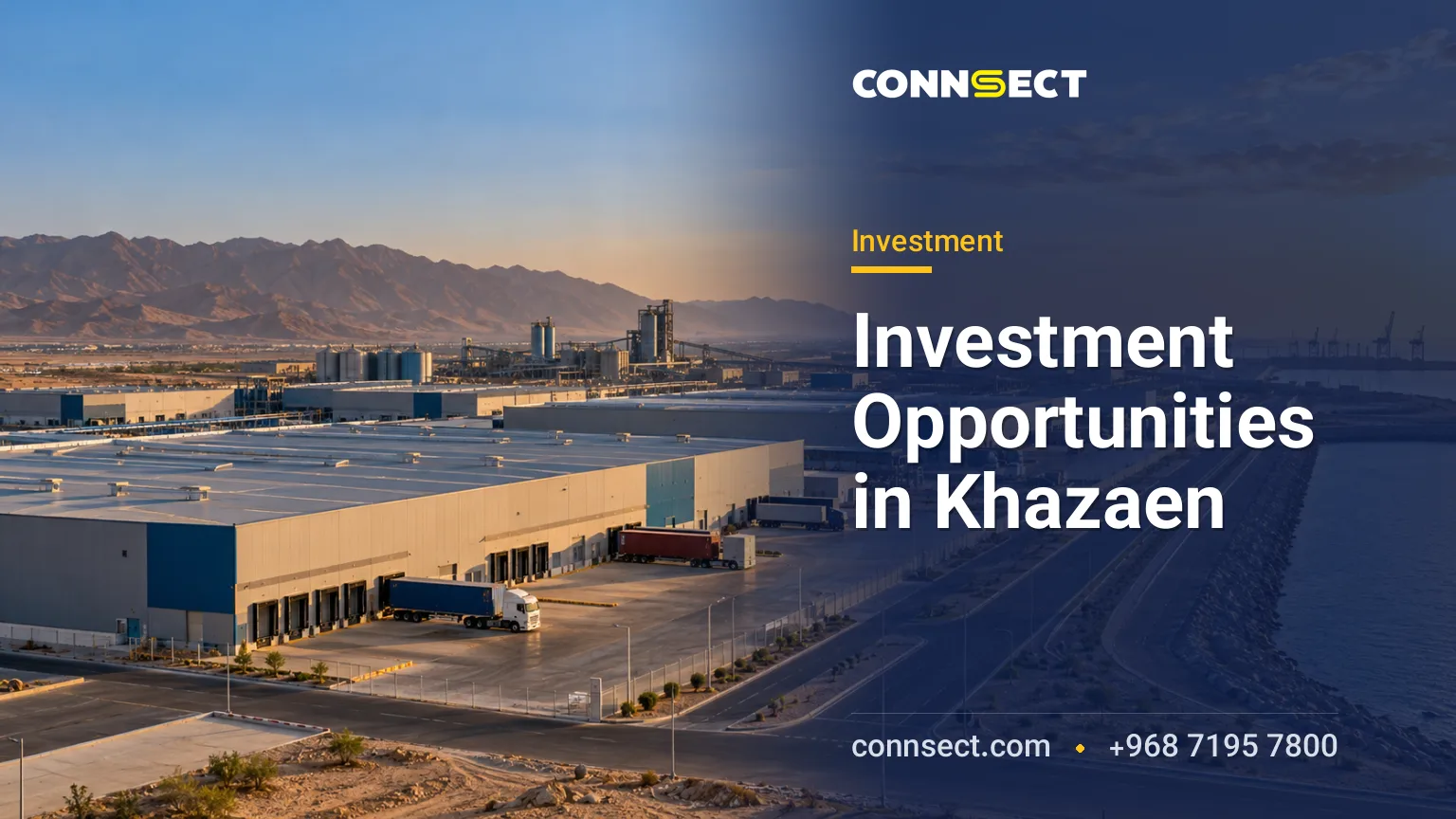
Investing in Khazaen Economic City in Oman is worth considering if your business needs industrial space, warehousing, distribution facilities, food-sector infrastructure or access to established transport routes. Located in Barka, South Al Batinah Governorate, Khazaen brings together industrial, logistics, commercial and other business uses. The right investment decision depends on your operating model, the site you need, applicable licences and the full cost of establishing and running the business.
At a glance
- Location: Barka, South Al Batinah Governorate, with connections to Oman's main road network.
- Business opportunities: Manufacturing, warehousing, logistics, distribution, food-related activities and commercial support services.
- Site options: Industrial land and ready-built industrial or storage units may be relevant, subject to availability and allocation terms.
- Investment process: Define the project, submit an application with supporting documents, proceed through site allocation and review the usufruct agreement.
- Regulatory context: The Public Authority for Special Economic Zones and Free Zones (OPAZ) oversees the relevant economic-zone framework.
- Budgeting: Assess site costs, service charges, licensing, equipment and operating expenses separately.
What makes Khazaen relevant to business investors?
Khazaen Economic City is a planned economic development combining industrial, logistics, commercial and supporting uses. Its location in Barka and connection to major roads make it a candidate for companies that need to move goods between suppliers, storage facilities, production sites and customers.
The official Khazaen overview describes a development that includes industrial and logistics areas, commercial facilities, a dry port and free-zone components. These uses serve different business requirements, so investors should identify the precise area and applicable operating conditions rather than treating the entire development as one uniform regulatory zone.
For a distributor, the priority may be warehouse capacity and efficient loading access. A manufacturer may need a suitable industrial plot, room for machinery and the right approvals for its production process. A food business may require specialised storage and handling facilities. The investment case is strongest when the selected site matches these practical requirements.
Which businesses should consider Khazaen?
Khazaen is particularly relevant to businesses whose operations depend on physical space, production, storage or the movement of goods. The suitability of any activity still depends on its permitted land use, technical requirements and licensing obligations.
Manufacturing and industrial production
Manufacturers, assembly operations, industrial maintenance businesses and producers of construction-related materials can assess Khazaen as a potential operating base. Before selecting a plot or unit, establish the required floor area, equipment specifications, utility needs and any environmental or sector-specific approvals applicable to the proposed operation.
Projects announced in April 2026 illustrate the range of industrial activity associated with Khazaen. These included projects involving adhesives, tile cutting and processing, infrastructure and cement-related products, pharmaceutical warehousing, and plastic pipe manufacturing. In May 2026, Oman's Ministry of Foreign Affairs also reported an agreement for a vehicle assembly and production project involving China's Spruce group.
These announcements provide examples of industrial investment interests, not a guarantee that an equivalent site is available or that another investor can operate under the same conditions. Each proposal must be assessed against the relevant site and licensing requirements.
Warehousing, logistics and distribution
Importers, exporters, wholesalers, distributors and logistics operators should assess Khazaen according to how goods enter, move through and leave the business. Important factors include storage capacity, loading arrangements, transport routes, inventory turnover and the handling requirements of the products involved.
Businesses dealing in temperature-sensitive products should evaluate cold-storage specifications and the conditions needed to maintain the supply chain. A warehouse that is suitable for general merchandise may not be suitable for food, pharmaceuticals or other products with specialised handling requirements.
Food production and fresh-produce supply chains
Khazaen's Food City concept is relevant to food processing, fresh-produce trading, distribution and supporting logistics. Businesses in this sector should assess the suitability of the premises alongside hygiene, storage, packaging, transport and product-specific licensing requirements.
A fresh-produce distributor may prioritise cold storage and rapid dispatch, while a food manufacturer may need production space and facilities appropriate to its processing operations. The proposed activity should determine the site requirements, rather than the broad label of food-sector investment.
Commercial and business-support services
Khazaen also identifies opportunities for commercial offices and supporting services, including information technology and professional business services. For a service company, the main considerations are whether its customers or operations benefit from a presence in the development, what premises are required and which activity licences apply.
A company that mainly provides remote consultancy may have different site needs from a business supporting manufacturers and logistics operators on location. Registering a company in Oman and selecting an operating site are related decisions, but one does not automatically settle the requirements of the other.
How to assess whether Khazaen fits your business
Start with operational requirements, then compare available site options against them. This is more useful than selecting a location based on general claims about investment advantages.
| Business model | Primary site requirement | What to evaluate |
|---|---|---|
| Manufacturing | Industrial land or production premises | Permitted use, space, technical infrastructure and sector licences |
| Warehousing and distribution | Storage facilities and transport access | Product type, capacity, loading arrangements and delivery routes |
| Food-related business | Suitable processing or storage premises | Hygiene requirements, cold-chain needs and product approvals |
| Import and export trading | Operational space and distribution access | Goods handled, applicable permits and logistics costs |
| Business-support services | Office or commercial premises | Customer access, premises costs and permitted activities |
Use this comparison to shortlist suitable premises, not as a substitute for checking the permitted use of a specific plot or unit. Before making a commitment, document the space required, expected goods movement, equipment, storage conditions and expansion plans.
How to establish a business in Khazaen
The practical route begins with defining the project and identifying a suitable site. The published investment process includes an application with supporting documents, site allocation and execution of a usufruct agreement, with the detailed steps depending on the proposed activity and arrangement.
- Define the business activity. Describe what the company will manufacture, store, trade or provide. Identify the products involved, target customers, supply routes and operating model.
- Specify the site requirements. Decide whether the project needs industrial land, a ready-built unit, a warehouse, temperature-controlled storage or commercial premises. Document the required area and technical facilities.
- Review investment options. Use the official Khazaen investment information to identify relevant sectors and contact the management team about site options, availability and allocation conditions.
- Prepare the application. Assemble the applicant's registration details, project description and supporting documents required for the proposed investment. Obtain the current document checklist for the specific application.
- Proceed through site assessment and allocation. Follow the designated review process and clarify the proposed site's permitted use, terms and obligations before accepting an allocation.
- Review the usufruct agreement. Check the permitted activity, payment obligations, conditions of use, duration and other contractual responsibilities before signing.
- Complete company registration and licensing requirements. Confirm that the company's registered activities, site arrangements and sector-specific approvals align with the intended operation. Do not assume that a site agreement replaces an operating licence.
- Prepare for operations. Arrange equipment, staffing, suppliers, transport, storage systems and other operational requirements. Start the activity only when the applicable legal and operational requirements have been met.
The exact sequence can vary with the project, the type of premises and the applicant's legal structure. Before making financial commitments, obtain the applicable procedure directly from Khazaen management and the relevant authorities.
Documents and requirements to prepare
A complete application should explain who is investing, what the business will do and what kind of site it needs. The final document list depends on the activity, applicant and proposed arrangement.
- Applicant information: Identification and company registration details appropriate to the application.
- Business description: A clear explanation of the proposed manufacturing, trading, storage, logistics or service activity.
- Site requirements: The intended use, required area, premises type and essential technical facilities.
- Supporting project documents: The documents requested by the relevant authority to evaluate the proposal.
- Company and activity licences: Registration records and approvals applicable to the business and its sector.
- Financial and operational planning: A working budget for the site, equipment, installation and launch.
Prepare the application around the actual project rather than relying on a generic checklist. Confirm whether additional approvals apply to activities such as food handling, pharmaceutical storage or industrial production before committing to premises or equipment.
Investment costs and setup timelines
The cost of establishing a business in Khazaen extends beyond land or warehouse rent. Investors should account for premises, service charges, registration, activity licences, equipment, installation and ongoing operating costs.
| Cost or timeline item | Planning basis | Next action |
|---|---|---|
| Land or premises | Site type, area, permitted use and contract terms | Request a project-specific commercial offer |
| Khazaen service charges | Applicable services and current fee rules | Review the relevant fee schedule and contractual obligations |
| Mainland company registration through Connsect | OMR 275; typically 7–10 working days | Review the Oman company registration service |
| Activity licences and technical approvals | Business activity and issuing authority | Identify the required approvals and applicable government charges |
| Equipment and site preparation | Technical specifications and operational needs | Prepare a separate installation and commissioning budget |
Connsect's published price for mainland Oman limited liability company registration, completed without the client travelling to Oman, is OMR 275, with a typical processing time of 7–10 working days. This service price is separate from site allocation, premises costs and any additional project-specific licences or approvals.
Plan the operational launch separately from company registration. Site allocation, contract execution, specialist approvals, equipment installation and operational readiness may involve distinct stages. Your launch schedule should reflect the actual requirements of the project rather than assuming that company registration alone makes the business ready to trade.
Free-zone status, tax incentives and regulatory distinctions
Khazaen includes free-zone components as well as other economic, industrial and commercial areas. The regulatory and commercial conditions should therefore be assessed for the specific location and activity rather than assumed to apply uniformly throughout the development.
Before relying on a tax or customs incentive, establish which rules apply to the proposed site, business structure and activity. Confirm the eligibility conditions and relevant obligations with Khazaen management and the responsible authority, and incorporate those conditions into the investment model.
General references to investment incentives or competitive land costs are not substitutes for a commercial offer and applicable legal terms. Compare the actual costs and benefits available to your project, including service charges, licensing, logistics and the requirements attached to any incentive.
Common mistakes when choosing a site
Most avoidable site-selection problems arise when the investor commits to premises before defining the operating requirements. Address the following points before signing a contract or purchasing equipment.
- Choosing a site before defining the activity: Specify the business process and technical needs first.
- Assuming the entire development has free-zone treatment: Check the rules for the particular area and activity.
- Budgeting only for rent: Include service charges, licences, equipment, installation, transport and operating costs.
- Overlooking sector approvals: Food, pharmaceutical and industrial operations may have distinct licensing and compliance requirements.
- Treating an application as a guaranteed allocation: Confirm the actual status of the application before making irreversible commitments.
- Comparing locations using marketing claims alone: Compare site costs, customer access, transport routes and technical suitability using the same criteria.
Frequently asked questions
Plan your Khazaen investment
Before selecting a site, document the proposed activity, space requirements, technical facilities, goods movement and expected operating costs. Use these requirements to compare suitable premises and identify the registration and licensing steps needed for your project.
Connsect can assist with Oman company registration, business-structure assessment and the practical steps involved in establishing a business. Its mainland company registration service is priced at OMR 275, with a typical processing time of 7–10 working days; Khazaen site and operating costs must be assessed separately.
Arrange a free initial consultation with Connsect to discuss your business model and registration requirements. For site availability, allocation terms and activity-specific approvals, obtain the applicable details directly from Khazaen management and the responsible authorities.




Comments & experiences
Share a useful experience or ask a relevant question.