

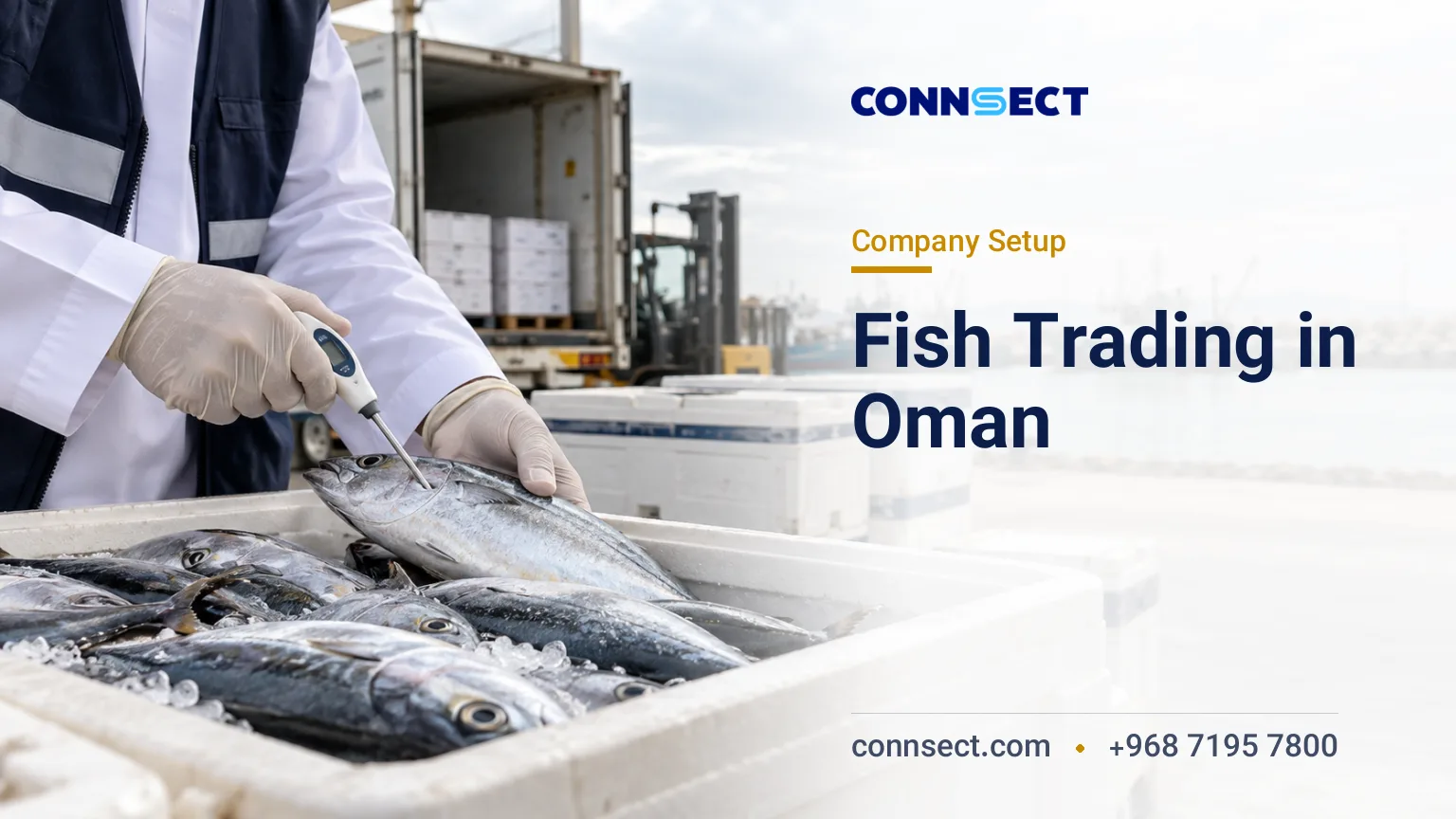
To establish a fish trading company in Oman, you need to choose commercial activities that match your actual business model, register the company and obtain any fisheries, quality-control, transport or shipment-specific approvals that apply. Buying fish from local suppliers and reselling it to restaurants is different from importing frozen seafood, exporting fresh fish or operating refrigerated transport. The right setup depends on which part of the seafood supply chain your company will handle.
At a glance
- Company registration is handled through Oman's commercial registration system under the Ministry of Commerce, Industry and Investment Promotion.
- Fish trading, importing seafood, exporting fish and transporting live aquatic resources can involve separate approvals.
- The published veterinary import permit fee for fish and fish products is OMR 10.
- The published annual licence fee for transporting and marketing living aquatic resources is OMR 11.
- Connsect charges OMR 275 for mainland limited liability company registration without requiring the applicant to travel to Oman, with a stated processing time of 7–10 working days.
Choose the right seafood business model
The first decision is whether your company will trade locally, import products, export Omani fish, distribute seafood or process it. Each model has different operational requirements, and registering a broad commercial activity does not automatically authorise every regulated operation.
Domestic trading and wholesale distribution
A company buying fish from local suppliers and selling to restaurants, hotels, retailers or other distributors should select commercial activities that reflect its actual trading operations. If you intend to operate as a buyer or seller at the Central Wholesale Fish Market in Al-Fulaij, Barka, a separate market-specific licence applies.
The Al-Fulaij service lists requirements including commercial registration, a municipal licence, Oman Chamber of Commerce and Industry membership and relevant fish transport and marketing documentation. This is a requirement for the market covered by that service, not a universal licence for every seafood trader in Oman.
Importing fish and seafood products
Importers must assess the requirements for the particular fish or fish product, its intended use and the shipment. The Directorate General of Customs lists a veterinary permit for importing fish, fish products and ornamental fish, alongside a separate service for medical certification of fish products intended for human consumption.
Import operations may require suitable storage, product traceability, temperature records and evidence that suppliers meet applicable health and safety requirements. Before placing an order, coordinate the required certificates with the supplier and establish how the shipment will be inspected and released.
Exporting fish from Oman
Export requirements depend on the product, species, destination and applicable restrictions. The government provides a dedicated fish export certificate service, while the Directorate General of Customs lists a separate single-use export permit.
Exports to the European Union may require a European Community catch certificate for shipments covered by the applicable rules. This destination-specific certificate should not be treated as a requirement for every export. Check species restrictions, seasonal controls and destination documentation before dispatching the shipment.
Refrigerated transport and live aquatic resources
Businesses transporting and marketing living aquatic resources should assess the dedicated transport and marketing licence. The application requirements include commercial registration, company affiliation documentation, refrigerated vehicle ownership, a health card and other applicable vehicle documents.
The published annual licence fee is OMR 11, and the stated service duration is one day. The licence covers the activity described by the government service; it should not be treated as a substitute for company registration or any import, export or market-specific approval. See the official transport and marketing licence requirements.
Who should establish a fish trading company in Oman?
This route is relevant to investors seeking to operate within Oman's seafood supply chain, whether they serve domestic customers or international markets. The proposed activities, ownership structure and operational facilities should be assessed together before registration.
- Wholesale suppliers selling seafood to restaurants, hotels and retailers.
- Importers bringing fresh, frozen or other fish products into Oman.
- Exporters preparing seafood shipments for regional or international buyers.
- Distributors operating refrigerated vehicles for seafood deliveries.
- Businesses buying or selling through the Al-Fulaij central wholesale fish market.
- Investors combining trading with storage or processing activities that may require additional approvals.
Foreign investors should assess the appropriate legal structure, ownership arrangements and any investment-licensing obligations that apply to their circumstances. Oman's official limited liability company registration service provides the general registration route, but specialist fisheries approvals remain a separate consideration.
How to register a fish trading company step by step
Define the business model before filing the registration application. This allows you to select appropriate commercial activities and identify the permits needed before purchasing stock, arranging transport or committing to a warehouse.
- Define your trading activities. Decide whether you will trade locally, import, export, distribute using refrigerated vehicles, sell through a wholesale market or process seafood. Identify the products you intend to handle.
- Select the legal structure. A mainland limited liability company is one available route. Review the ownership structure and any investment-licensing requirements relevant to foreign shareholders.
- Choose the commercial activities. Ensure that the activities entered in the commercial register reflect the operations the company will actually perform. Confirm whether additional activities require separate approvals.
- Complete commercial registration. Submit the required company information and supporting documents through the official registration process. Keep company formation costs separate from sector-specific licence costs.
- Obtain applicable operational permits. Check the transport and marketing licence if you handle living aquatic resources, the market-specific licence if you operate at Al-Fulaij, and the appropriate veterinary or export services for international shipments.
- Prepare storage and transport arrangements. Where relevant, arrange suitable warehouses, refrigeration, temperature monitoring and records that support product traceability and safety.
- Prepare shipment documentation. Coordinate import certificates with suppliers and obtain the export documents required for the species and destination before dispatch.
- Check compliance before trading. Verify that the registered activities, premises, transport arrangements and shipment documentation match the intended operation.
Documents and operational requirements
The documents required depend on the company structure and the activities being licensed. Company registration documents should be organised separately from transport, warehouse and shipment records.
- Company formation: Identification documents for shareholders and the supporting information required for the selected legal structure.
- Investment licensing, where applicable: The published government checklist includes a passport copy, feasibility study, evidence of experience, a bank statement covering at least three months and a lease contract.
- Fish imports: The applicable veterinary permit documentation and test certificate, together with the shipment and supplier records required for the product.
- Warehousing and quality control: Suitable storage, health and safety compliance, and records of imported species and quantities, expiry dates, warehouse temperatures and stock.
- Transport and marketing: Commercial registration, company affiliation documentation, refrigerated vehicle ownership, a health card and other applicable vehicle documents.
- Central wholesale market operations: Commercial registration, municipal licensing, chamber membership and the relevant transport and marketing documentation.
- Fish exports: A company request letter and evidence that the fish was purchased from landing centres or wholesale markets at fishing ports, alongside the applicable trading, marketing and quality-control documentation.
- EU-bound shipments: Where the catch certificate rules apply, prepare the relevant fishing-vessel information, supporting fishing-licence details and quality-control number.
For imports, review the veterinary fish import permit and, where relevant, the medical certificate for fish products intended for human consumption. The correct service depends on the product and transaction; one certificate should not be assumed to cover every shipment.
Registration costs and permit timelines
Budget for company formation separately from fisheries permits, market approvals, storage, refrigerated vehicles and shipment certification. Published service fees and processing targets apply to individual services and do not represent a guaranteed end-to-end launch timeline.
| Service | Published fee | Stated timeframe |
|---|---|---|
| Connsect mainland LLC registration without client travel | OMR 275 | 7–10 working days |
| Initial Connsect consultation | Free | Arranged through the consultation service |
| Veterinary permit to import fish and fish products | OMR 10 | Two-hour approval target during official working hours |
| Single-use export permit | OMR 2 plus OMR 0.200 for the Agricultural Development Fund | Two-hour approval target during official working hours |
| Fish export certificate | Free | Two days |
| European Community catch certificate for applicable exports | Free | One to three days |
| Annual transport and marketing licence for living aquatic resources | OMR 11 | One day |
| Investment licence for eligible applicants | OMR 0.900 | Seven-minute service target |
Government service targets do not include every preparation, inspection, supplier-documentation or company-formation step. Additional expenditure may arise from premises, refrigeration, vehicle requirements, municipal licensing and other approvals applicable to the business model.
Connsect's published price for mainland limited liability company registration is OMR 275 (approximately USD 716), with a stated timeframe of 7–10 working days, without requiring the client to travel to Oman. See the company registration service for the service details. Banking and tax services are quoted after the free review.
Common mistakes to avoid
Most preventable problems arise when a company treats registration as permission to perform every seafood-related operation. Match the registered activities, facilities and shipment documents to the actual business before committing to stock or transport.
- Choosing an overly broad or inaccurate activity: Define the company's actual trading, import, export and transport operations before registration.
- Assuming company registration covers fisheries permits: Commercial registration and operational approvals serve different purposes.
- Ordering imported seafood before checking documentation: Coordinate supplier certificates, applicable inspections and storage requirements before shipment.
- Using one export document for every destination: A fish export certificate, single-use export permit and destination-specific catch certificate are different services.
- Overlooking cold-chain controls: Plan appropriate refrigeration, storage and temperature records for products that require controlled conditions.
- Applying market-specific requirements universally: The Al-Fulaij market licence applies to that market, rather than every seafood business in Oman.
- Ignoring species and seasonal restrictions: Check the applicable controls and destination requirements before exporting regulated fish.
Frequently asked questions
Plan your Oman seafood business with Connsect
Before registering, establish whether your business will focus on local wholesale, importing, exporting, distribution or transport. That decision determines which commercial activities and specialist approvals need to be addressed first.
Connsect supports company registration and investor-related services in Oman. Start with a free initial consultation to discuss your proposed activities, ownership structure and registration route before committing to premises or seafood shipments.






Comments & experiences
Share a useful experience or ask a relevant question.