

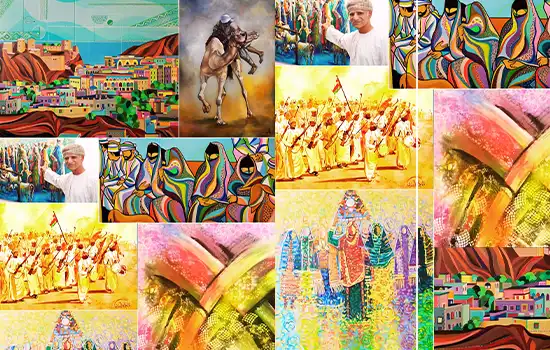
Omani visual arts offer a way to understand how cultural heritage, the natural environment and everyday experience are interpreted through images and artistic practice. Traditional architecture, Islamic geometric patterns, handicrafts and local customs may appear alongside contemporary subjects, but there is no single visual style that defines every Omani artist. The meaning of an artwork depends on its subject, the artist's choices and the historical or social context in which it was created.
For visitors, researchers and anyone interested in Oman's cultural life, three starting points are particularly useful: exploring the country's visual heritage, visiting the National Museum of Oman and following exhibitions and workshops organized by the Omani Arts Society. International exhibitions also offer opportunities to encounter Omani art beyond the country's borders.

How visual art expresses Omani cultural identity
Omani visual arts can communicate cultural identity through architecture, decorative motifs, traditional crafts, clothing and scenes of local life. Artists select and reinterpret these elements in different ways; some may emphasize historical references, while others explore personal experience or contemporary society. Recognizing a familiar cultural symbol is only the beginning of interpretation, not a complete explanation of an artwork.
Architecture provides one useful point of reference. Buildings, doors, decorative details and geometric designs can reflect the materials, craftsmanship and aesthetic traditions associated with particular places. When examining an artwork that incorporates these features, consider how the artist uses scale, color, composition and context rather than assuming that a motif has the same meaning in every work.
Oman's varied geography offers another source of visual inspiration. Mountains, desert landscapes, coastlines and maritime environments can shape artistic choices and provide subjects for exploring the relationship between people and their surroundings. A landscape may communicate a personal memory, an observation of the natural world or a particular artistic interpretation; its cultural meaning should be understood in relation to the work itself.

Contemporary life and the work of Omani artists
Visual art can document and interpret social experience as well as preserve references to the past. Family relationships, everyday activities, local customs and urban environments may become subjects through which artists explore continuity and change in Omani society.
The relationship between artists and their communities develops through creating work, participating in cultural events and presenting ideas to audiences. Exhibitions give viewers opportunities to encounter different perspectives, while workshops and other cultural activities can encourage discussion and practical engagement with artistic techniques.
It is important not to treat Omani artists as a single group with identical interests. Individual practices can differ in subject matter, medium, technique and approach to cultural heritage. Looking at the choices made by each artist provides a more accurate understanding than expecting every work to represent the same national symbols or traditions.
For information about exhibitions, workshops and developments in the country's visual arts, consult the Omani Arts Society's programmes. Its activities provide a practical starting point for learning about local artistic initiatives and opportunities to engage with the arts.

Where to explore Omani art and cultural heritage
The National Museum of Oman is a useful starting point for understanding the historical and cultural context behind many subjects found in Omani art. Its collections and exhibition spaces connect objects and historical themes with broader narratives about the country and its relationships with the wider world.
The museum's permanent galleries cover subjects including maritime history, aflaj irrigation systems, ancient history, intangible heritage and Oman's connections with other societies. Temporary exhibition spaces also provide opportunities to encounter different presentations of cultural material. The museum's permanent gallery themes help visitors identify areas of interest before planning a visit.
When exploring a museum collection, read the accompanying descriptions and consider the historical setting of each object. An artifact, decorative pattern or traditional craft may have a different significance depending on its origin, use and period. Connecting individual objects to their context makes it easier to understand how heritage is preserved and interpreted.
The Omani Arts Society offers a complementary route, particularly for people interested in exhibitions, workshops and visual-art practices. Following its official announcements and activities can help visitors identify relevant programmes and learn more about artistic work in Oman. Check the organizer's current announcements for event dates and visiting arrangements.
How museums help preserve cultural identity
Museums contribute to cultural preservation through both public interpretation and the physical care of collections. Exhibitions make historical objects and cultural narratives accessible, while conservation and restoration help safeguard collection materials for the future.
The National Museum of Oman provides facilities for the conservation and restoration of its collections. Its work connects the presentation of heritage to the practical requirements of caring for objects over time. Visitors can learn about this role through the museum's information on heritage conservation and restoration.
Preservation also involves how cultural knowledge is communicated to younger generations. Museum displays, educational activities, explanations of traditional techniques and opportunities to observe historical objects can help people understand the context behind cultural practices. These activities complement the work of artists and communities, although their effects vary according to the programme, audience and subject.
Contemporary artistic expression and heritage conservation serve related but distinct purposes. Conservation focuses on caring for existing collections, while artists may reinterpret inherited forms, question established representations or develop new visual languages. Both can contribute to ongoing discussions about cultural identity without requiring every contemporary artwork to reproduce traditional imagery.

Omani visual arts on the international stage
International exhibitions provide opportunities to present Omani artistic history to audiences outside the country. They can also place individual works within broader conversations about modern art, cultural exchange and the interpretation of national heritage.
Oman's participation in the 2026 Venice Art Biennale is one example of its engagement with an international art platform, as reported through the Ministry of Culture, Sports and Youth's cultural activities.
Another documented example is the exhibition of pioneers of Omani visual art, which opened in Moscow on 18 May 2026 in collaboration with the National Museum of Oman and the State Tretyakov Gallery. The exhibition presented the development of Omani art from the mid-twentieth century. The Ministry of Foreign Affairs' announcement about the Moscow exhibition provides further information about this event.
Such exhibitions make artistic histories available to wider audiences and create opportunities to examine how Omani artists have approached visual expression across different periods. They should be understood as specific cultural initiatives rather than evidence that all artists share one style or interpretation of national identity.

How to build a deeper understanding of Omani art
A useful approach combines direct observation, historical context and attention to the artist's individual choices. Rather than identifying a work only by its traditional motifs, consider how its subject, technique and presentation shape its meaning.
- Start with the subject. Identify whether the work focuses on architecture, landscape, craft, everyday life or another theme.
- Examine the visual choices. Look at color, composition, materials, patterns and the relationship between different elements.
- Establish the context. Read the artist's description or the exhibition label to understand the period, setting and intended subject.
- Visit cultural institutions. Use the National Museum of Oman to explore historical collections and the Omani Arts Society to follow artistic programmes.
- Compare different works. Consider how artists approach similar subjects in different ways instead of assuming that one artwork represents the entire country.
- Follow official event information. Check announcements from the relevant institution before arranging a visit to an exhibition or workshop.
This method helps distinguish historical evidence from artistic interpretation. It also provides a more useful framework for understanding the relationship between heritage and contemporary visual culture.

Frequently asked questions about Omani visual arts
Explore Oman's cultural institutions
To continue learning about Omani visual arts, begin with the National Museum of Oman for historical context and collection interpretation, then follow the Omani Arts Society for exhibitions and workshops. Together, these institutions offer complementary ways to explore the country's artistic heritage and contemporary cultural activity.






Comments & experiences
Share a useful experience or ask a relevant question.