

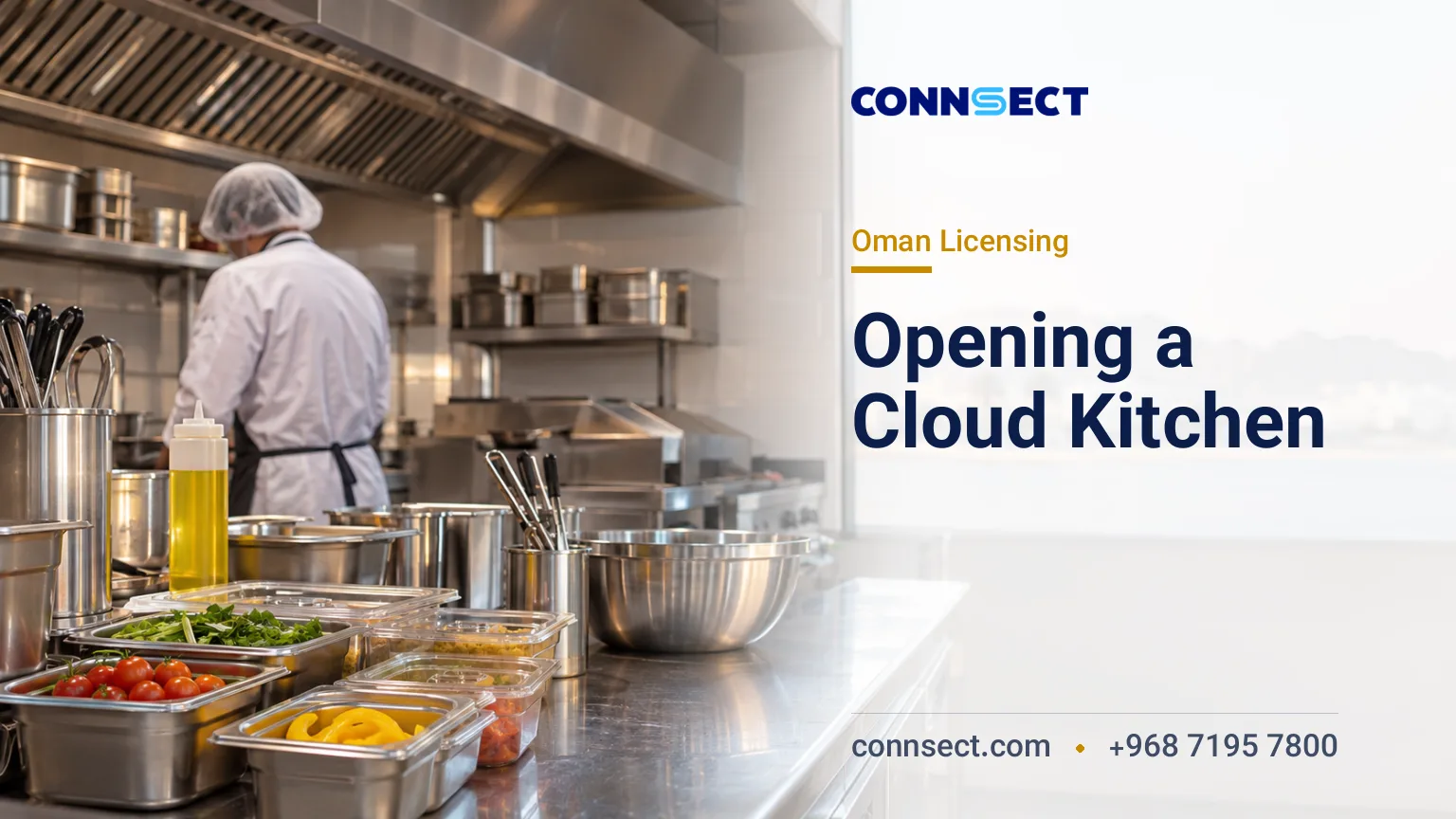
Opening a cloud kitchen in Oman requires more than registering a company. You need an appropriate commercial activity, an approved food-preparation premises, municipal licensing and compliance with food-safety requirements. Although a cloud kitchen operates without a customer dining area, the kitchen itself remains subject to the rules governing commercial food preparation. The safest approach is to confirm the permitted activity and premises requirements before signing a lease or purchasing equipment.
At a glance
- A cloud kitchen prepares food primarily for online orders and delivery rather than dine-in customers.
- Company registration and municipal approval for the operating premises are separate requirements.
- Muscat Municipality publishes specific health requirements for kitchens and food-preparation businesses.
- Food handlers may need valid health certificates, periodic medical examinations and appropriate training.
- Talabat Oman requires commercial documentation when onboarding restaurant partners.
- Connsect offers mainland LLC registration for OMR 275, with a stated processing time of 7–10 working days.
What is a cloud kitchen, and how does it work in Oman?
A cloud kitchen is a commercial food-preparation facility that sells meals primarily through online ordering and delivery channels. Customers do not visit the premises to dine. Instead, the business receives orders digitally, prepares the food, packages it and arranges delivery through its own drivers or a delivery platform.
This model differs operationally from a conventional restaurant. A dine-in restaurant needs customer seating, service areas and facilities for guests. A cloud kitchen concentrates its investment on cooking equipment, refrigeration, food preparation, packaging and order management.
The distinction matters when selecting premises and planning expenditure, but it does not remove food-safety obligations. A business preparing meals for commercial sale must comply with the applicable municipal requirements for its premises and activities.
In Muscat, the relevant framework includes Local Order No. 1/2006 concerning public-health protection and Administrative Decision No. 168/2011, which establishes activity-specific health requirements. The broader statutory framework includes Royal Decree 84/2008, which promulgated Oman's Food Safety Law.
Muscat Municipality provides an official list of public-health activity requirements, including requirements relevant to kitchens, restaurants and food preparation.
Who should consider opening a cloud kitchen?
A cloud kitchen can suit entrepreneurs who want to enter Oman's food market without investing in a full customer-facing restaurant. It is particularly relevant to food entrepreneurs, existing restaurant operators, hospitality investors and businesses developing delivery-focused food brands.
Foreign investors entering the food sector
For foreign investors, the first consideration is the legal structure and permitted commercial activity. Company registration establishes the business, but it does not automatically authorise every food-related operation. The activity recorded for the company must match the work carried out at the premises.
Investors should therefore determine whether their proposed operation involves meal preparation, food production, packaging or additional food-related services. The exact activity description should be checked with the Ministry of Commerce, Industry and Investment Promotion before committing to a property.
Existing restaurants and virtual food brands
Restaurant operators may use a delivery-only kitchen to introduce additional menus or test virtual brands without opening another dining venue. A single kitchen may support more than one commercial food brand, provided the actual activities and premises remain within the scope of the applicable approvals.
Do not assume that approval for one activity automatically covers every additional brand or food operation. Discuss the proposed operating model with the competent municipality before expanding the menu or adding activities.
How to establish a cloud kitchen in Oman: step by step
The establishment process should begin with commercial activity selection and premises assessment. Company registration, municipal approval, kitchen preparation, staff compliance and delivery-platform onboarding then follow in a controlled sequence.
- Define the operating model. Decide whether the business will prepare individual meals, operate several virtual brands, provide corporate catering or offer other food-related services. This determines which commercial activities need to be considered.
- Select the commercial activity. Work with the Ministry of Commerce, Industry and Investment Promotion to identify the appropriate activity description. The registered activity should reflect the actual food preparation and sales operation rather than relying on a generic business category.
- Register the company. Complete the commercial registration process and establish the appropriate legal structure. A mainland limited liability company is one available business structure. Review the company registration service in Oman before proceeding.
- Assess the proposed premises. Check the property's permitted use, water and electricity supply, drainage, ventilation and suitability for commercial kitchen equipment. Obtain municipal guidance on the proposed food activity before entering into a long-term lease.
- Apply for municipal approval. Submit the premises and activity details to the competent municipality. In Muscat, the municipality's health requirements cover kitchens and other food-related activities. The business must obtain the relevant municipal licence before operating.
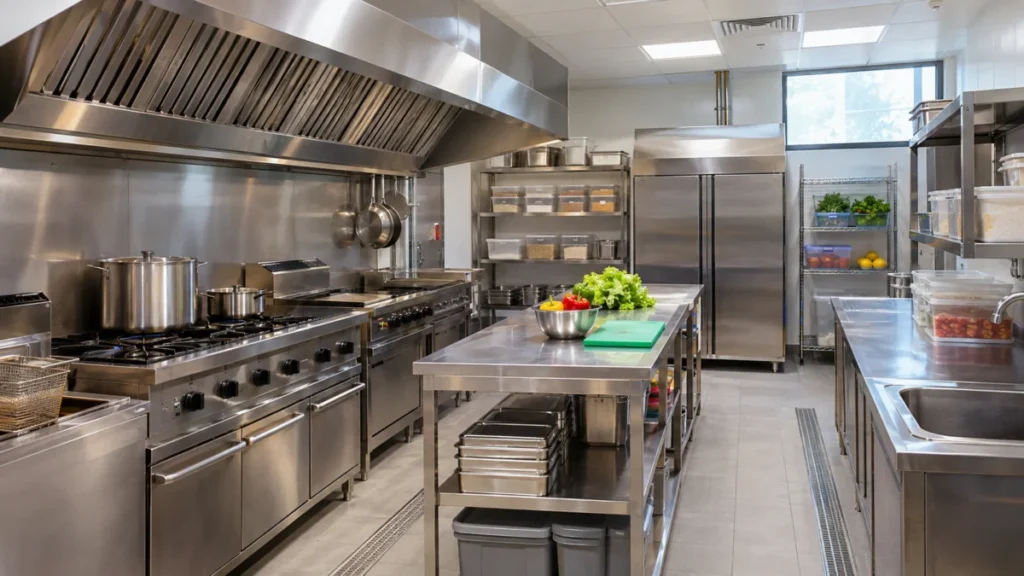
- Prepare the kitchen. Install suitable cooking equipment, refrigeration, preparation surfaces, washing facilities, ventilation and food-storage arrangements. The layout should support hygienic movement from receiving ingredients to preparation, cooking and packaging.
- Complete employee health requirements. Arrange the required health certificates and periodic medical examinations for relevant food handlers. Ensure that employees meet the applicable hygiene, training and qualification requirements.
- Prepare for inspection. Check cleaning procedures, pest control, waste disposal, water supply, drainage, equipment condition and food storage. The premises must satisfy the applicable municipal health and safety requirements.
- Register for tax. Complete the required registration with the Oman Tax Authority. Income-tax registration is required within 60 days of commencing activity or registering with the Ministry of Commerce, Industry and Investment Promotion, as applicable.
- Apply to delivery platforms. Once the business documentation and operating approvals are in place, approach delivery platforms such as Talabat Oman. Prepare the commercial documents, banking information and brand assets required for partner onboarding.
Cloud kitchen premises and food-safety requirements
The kitchen premises are central to the licensing process. The absence of dining facilities does not change the need for hygienic food preparation, suitable infrastructure and effective controls over storage, handling and waste.
Premises and infrastructure
Before selecting a property, assess whether its physical layout can support the proposed kitchen operation. A property that works as a domestic kitchen may not be suitable for commercial food preparation.
- Water supply: Adequate water facilities must support food preparation and cleaning.
- Drainage: The premises should have suitable sewage and wastewater arrangements.
- Ventilation: Cooking equipment requires an appropriate extraction and ventilation system.
- Preparation surfaces: Food-contact surfaces should support effective cleaning and hygienic handling.
- Storage: Ingredients and food products need suitable storage arrangements.
- Waste management: Waste must be collected and disposed of hygienically.
- Pest control: Preventive measures should protect the premises from insects and rodents.
- Safety: Electrical installations and kitchen equipment must be suitable for the operating environment.
Municipal inspections can assess premises conditions, electricity, water, sewage, hygiene, pest control, safety and workforce arrangements. These are practical considerations to address during property selection and kitchen design, rather than after the equipment has been installed.
Essential commercial kitchen equipment
Equipment requirements depend on the menu, production volume and approved layout. A delivery-focused operation should prioritise reliable cooking, refrigeration, hygienic preparation and packaging facilities.
- Commercial cooking ranges, ovens and food-preparation equipment.
- Commercial refrigerators and freezers.
- Stainless-steel preparation counters and suitable food-contact surfaces.
- Commercial sinks and washing facilities.
- Extraction hoods and ventilation equipment.
- Food-storage shelves and containers.
- Temperature-monitoring equipment.
- Food-grade takeaway containers and packaging materials.
- Cleaning and sanitising supplies stored separately from food.
- Appropriate safety and hygiene equipment.
Packaging deserves particular attention. Food must remain suitable for consumption during preparation, handling and delivery. Packaging should match the meal type and expected transport conditions, while the packing station should be organised to avoid contamination or interference with food preparation.
Food handlers and employee health
Food handlers are an important part of the compliance process. Employees involved in public-health-related activities must satisfy the relevant health requirements, including valid health certificates and periodic medical examinations.
Muscat Municipality's published requirements also address employee hygiene, appropriate work clothing, handwashing facilities, liquid soap and sterilising materials. Smoking is prohibited in the relevant food premises, and employees must follow hygienic food-handling practices.
Training and qualification requirements should be considered when recruiting kitchen staff. Prepare employee documentation before operations begin rather than waiting for an inspection to identify missing records.
See the municipality's food establishment employee health requirements for further guidance.
Documents required for company registration and municipal licensing
Documentation depends on the legal structure, selected commercial activity and proposed premises. Keep the company registration documents separate from the property and food-safety file so that each approval stage can be managed efficiently.
Company and commercial documents
- Identification documents for shareholders and company representatives.
- Proposed company name and legal structure.
- Shareholder and management details.
- Description of the proposed commercial activity.
- Commercial registration application and supporting documents.
- Additional documents required for the selected activity.
Premises and health documentation
- Property ownership or tenancy documents.
- Premises plans and kitchen layout information.
- Details of water, electricity and drainage facilities.
- Information about cooking, refrigeration and preparation equipment.
- Employee health certificates and relevant medical records.
- Additional documents requested by the competent municipality.
If the business intends to introduce additional activities or facilities, obtain the municipality's approval before implementing the change. Operating beyond the approved scope can create licensing and inspection problems.
Cloud kitchen setup costs and processing times
The total investment includes company registration, premises, municipal licensing, kitchen fit-out, equipment, ingredients, staff and packaging. These expenses should be calculated separately because rent, production capacity and kitchen design can substantially change the operating budget.
| Service or expense | Price or timeframe | Details |
|---|---|---|
| Connsect mainland LLC registration | OMR 275 | Company registration without requiring the client to travel to Oman. |
| Company registration processing | 7–10 working days | Connsect's stated service timeframe. |
| Company registration and one-year investor visa package | OMR 920 | Combined company registration and one-year investor visa service. |
| Company registration and two-year investor visa package | OMR 1,090 | Combined company registration and two-year investor visa service. |
| One-year investor visa service | OMR 625 | Includes business plan, municipal licence, visa, medical test and Oman ID card. |
| Two-year investor visa service | OMR 795 | Includes business plan, municipal licence, visa, medical test and Oman ID card. |
| Investor visa processing | 20–30 working days | Connsect's stated processing timeframe. |
| Initial Connsect consultation | Free | Initial review of the proposed business and establishment route. |
These are Connsect service prices, not a complete cloud kitchen investment budget. Property rental, equipment, fit-out, ingredients, staff and payments to the relevant government authorities must be considered separately.
For the exact company registration service and scope, visit Connsect's Oman company registration page.
Tax registration and VAT
Commercial operators must also account for their tax obligations. Income-tax registration is mandatory for establishments conducting economic activities in Oman. The applicable registration deadline is 60 days from commencement of activity or registration with the Ministry of Commerce, Industry and Investment Promotion, as applicable.
Businesses must also maintain accounting records and supporting documents and submit annual tax returns. This is particularly important for cloud kitchens receiving payments through several delivery channels and managing ingredient, packaging and operational expenses.
Mandatory VAT registration applies when annual taxable supplies reach, or are expected to reach, OMR 38,500. The threshold relates to taxable supplies, not automatically to every amount received by the business.
Use the Oman Tax Authority registration portal and its VAT registration guidance to manage the applicable requirements.
Registering your cloud kitchen with Talabat Oman
Once the business has the required commercial documentation and can legally operate, it can apply to join food-delivery platforms. Talabat Oman operates a partner onboarding process for restaurants and food businesses.
The partner documentation includes:
- Valid trade licence.
- Commercial registration.
- National identification document.
- VAT documentation, where applicable.
- Power of attorney, where applicable.
- Bank certificate.
- Signed email declaration.
- Brand logo and cover image.
Talabat indicates an approximate delivery coverage radius based on 15 minutes of driving from the business location. This makes location selection a commercial decision as well as a licensing consideration. A kitchen positioned near its target customer areas may be better placed to serve its intended delivery market.
Platform acceptance does not replace government approvals. The business must maintain the required commercial and municipal documentation independently of its delivery-platform agreement.
Applications and partner information are available through the Talabat Oman partner portal.
Cloud kitchen vs. traditional restaurant in Oman
The main difference is the customer-facing operation, not the responsibility for safe food preparation. A cloud kitchen removes the need for a conventional dining area, while both business models remain subject to applicable food-premises and municipal requirements.
| Factor | Cloud kitchen | Traditional restaurant |
|---|---|---|
| Customer dining | Delivery-focused; no dining area required. | Provides dine-in facilities. |
| Premises design | Centred on production, storage and packaging. | Includes kitchen and customer service areas. |
| Primary sales channel | Online ordering and delivery. | Dine-in and potentially delivery. |
| Equipment priorities | Cooking, refrigeration, preparation and packaging. | Cooking, preparation and customer service. |
| Food hygiene obligations | Required. | Required. |
| Municipal premises approval | Required according to the approved activity. | Required according to the approved activity. |
Removing customer seating may reduce the space needed for the operation, but it does not remove the need for an appropriate food establishment licence. For a comparison with the conventional restaurant model, read Connsect's guide to restaurant licensing in Oman.
Common mistakes when opening a cloud kitchen
Many avoidable problems arise from decisions made before the first order is received. Property selection, commercial activity classification and kitchen design should be treated as connected parts of the licensing process.
- Leasing unsuitable premises: A residential kitchen is not automatically suitable for commercial food preparation. Check the property's permitted use and municipal requirements first.
- Choosing the wrong commercial activity: The registered activity must reflect the actual operation. A mismatch can complicate municipal approval.
- Assuming delivery-only businesses are exempt: No dining area does not mean no food-safety or municipal obligations.
- Buying equipment too early: Confirm the premises layout and infrastructure before purchasing industrial appliances.
- Ignoring employee documentation: Health certificates and periodic medical examinations should be managed before staff start handling food.
- Expanding activities without approval: Adding new food operations or facilities requires prior municipal consideration.
- Starting operations before licensing: A commercial registration or delivery-platform application does not authorise an otherwise unlicensed food premises.
- Overlooking tax compliance: Company registration should be followed by the applicable tax registration and accounting procedures.
Frequently asked questions
Establish your cloud kitchen business with Connsect
Before investing in a commercial kitchen, establish three things: the correct company activity, a premises suitable for the intended food operation and a clear municipal approval route. These decisions determine the registration process, kitchen layout and documents needed before trading.
Connsect assists entrepreneurs and foreign investors with company registration, investor residency procedures and business establishment in Oman. Mainland LLC registration is available for OMR 275, with a stated processing time of 7–10 working days. The initial consultation is free.
Submit your project details through Connsect's consultation and business setup request page to assess the company structure, registration requirements and next steps for establishing your cloud kitchen in Oman.




Comments & experiences
Share a useful experience or ask a relevant question.