

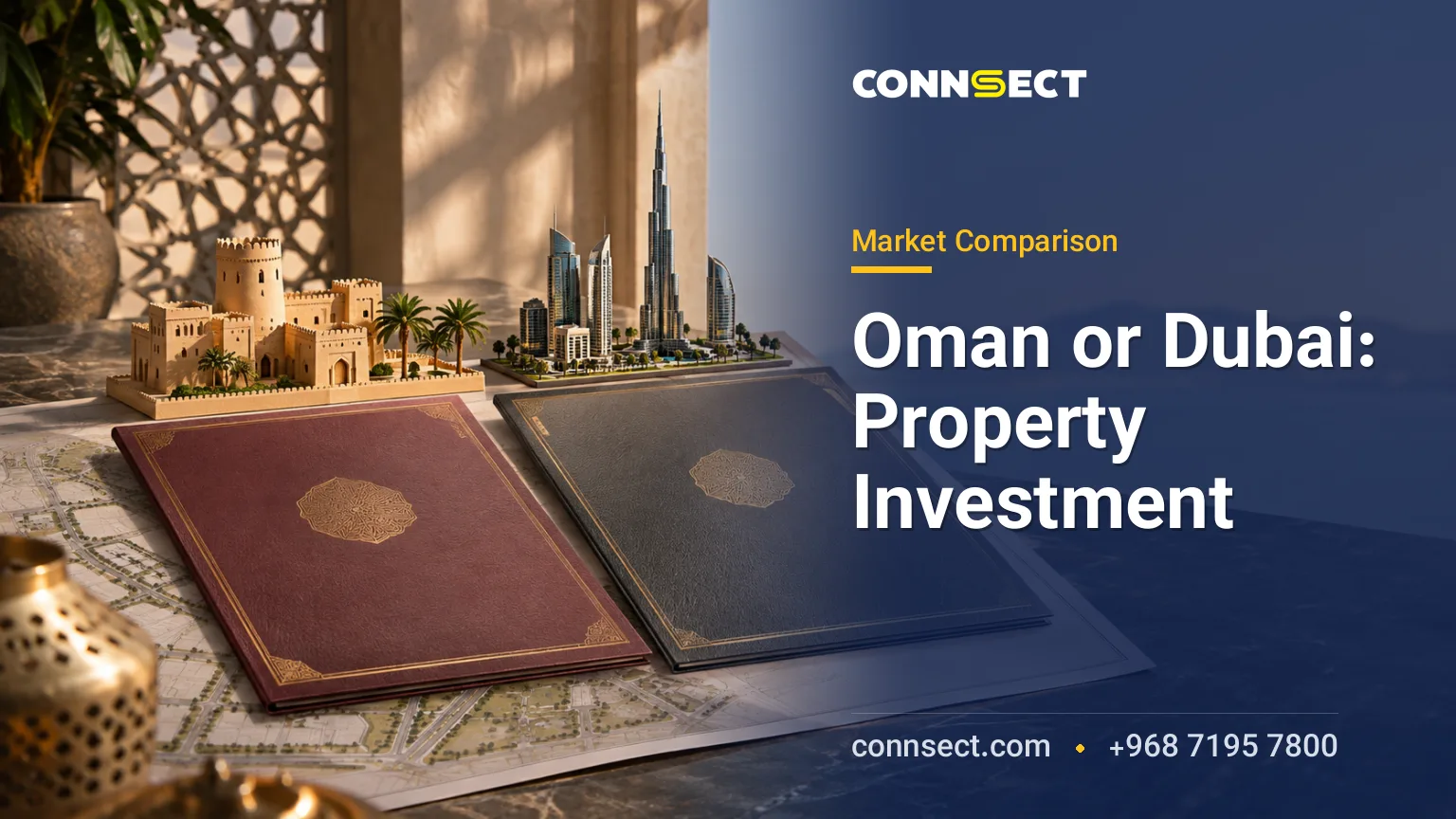
Buying Property in Oman or Dubai: Which Market Fits Your Investment Goals?
Buying property in Oman or Dubai involves two different ownership systems, residency routes and investment markets. Dubai offers foreign buyers freehold ownership in designated areas and a broad range of residential developments. Oman provides foreign ownership opportunities in licensed Integrated Tourism Complexes (ITCs), alongside property-linked residency options and longer-term investor residency programmes. The better choice depends on whether your priority is rental income, long-term residence, capital preservation or resale flexibility.
Price alone is not a reliable basis for choosing between the two markets. A property must be legally eligible for foreign ownership, its transfer costs must fit your budget, and any residency expectations must match the relevant immigration programme. Investors should assess these factors before signing a reservation agreement or transferring a deposit.
At a glance
- Foreign nationals can own eligible property in Oman’s licensed Integrated Tourism Complexes, subject to the applicable restrictions.
- Foreign buyers can acquire freehold property in designated Dubai areas without first holding UAE residency.
- Qualifying residential property ownership in an Omani ITC can provide access to a two-year residence visa.
- Oman’s five-year and ten-year Golden Residency routes are separate from the ordinary property-owner residence visa.
- Dubai property sale registration carries a stated transfer fee of 4% in total, allocated as 2% to the seller and 2% to the buyer.
- Rental yields depend on property type, location, service charges, maintenance and vacancy periods. Gross yields are not guaranteed net returns.
How Oman and Dubai Differ for Foreign Property Investors
The main distinction is the legal framework governing foreign ownership. Dubai allows non-UAE nationals to acquire freehold property in designated areas, while Oman applies a more restricted framework based on approved developments and specific investment programmes.
In Oman, the Integrated Tourism Complex framework allows non-Omanis to own land and property units within licensed developments. However, this does not create a general right to purchase any residential property or plot anywhere in the country.
Dubai's designated freehold areas provide a wider choice of residential investment locations. Foreign buyers, including non-residents, can purchase eligible properties and register ownership through the Dubai Land Department.
| Investment factor | Oman | Dubai |
|---|---|---|
| Foreign ownership | Eligible properties in licensed ITCs and qualifying investment routes | Freehold ownership in designated areas |
| Purchase without existing residency | Possible for eligible developments, subject to applicable requirements | Available to foreign non-residents |
| Registration authority | Ministry of Housing and Urban Planning | Dubai Land Department |
| Property-linked residency | Two-year property-owner route and separate investment residency routes | Property-owner residency and Golden Visa routes |
| Property transfer fee | 3% for applicable property sale registration transactions | 4% total, generally allocated equally between buyer and seller |
| Rental investment | Varies by project, location and facilities | Varies by district, property type and tenant demand |
Foreign Property Ownership Rules in Oman
Foreign nationals can purchase qualifying residential and investment property in licensed Integrated Tourism Complexes. The legal status of the specific development is essential: a property being located in a tourist destination does not automatically make it eligible for foreign ownership.
What is an Integrated Tourism Complex?
An ITC is an authorised development established for tourism and residential purposes. Oman's property ownership framework permits non-Omani individuals and legal entities to own land and property units within these licensed developments, subject to the applicable regulations.
Before purchasing, ask the developer or seller for the property's ownership documentation and evidence of the development's legal status. The property's location, registration details and eligibility for transfer to a foreign buyer should be checked before any deposit is paid.
Where are foreign buyers restricted from owning property?
Oman also has legislation restricting non-Omani ownership in specified locations. Restrictions cover Musandam, Al Buraimi, Al Dhahirah and Al Wusta Governorates, and areas of Dhofar other than Salalah. They also cover designated coastal locations, islands, certain mountainous areas and agricultural land throughout the governorates.
Additional restrictions apply to specified areas near military and security facilities, certain government sites and protected archaeological or heritage locations. These restrictions make a property-specific legal check particularly important when a buyer is considering a plot outside an approved tourism development.
Do not assume that a private sale agreement or a seller's assurance overrides these restrictions. The legal eligibility of the property and the buyer's right to register ownership must be established before committing funds.
Buying Freehold Property in Dubai as a Foreigner
Dubai permits foreign nationals to own freehold property in designated areas. Buyers do not generally need to obtain UAE residency before purchasing, making the market accessible to international investors who live elsewhere.
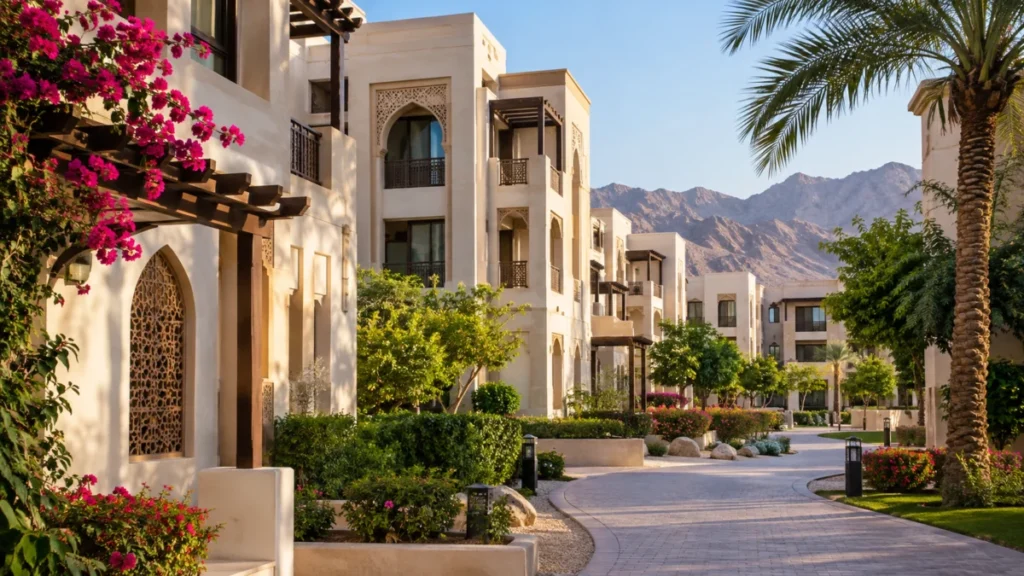
The Dubai Land Department (DLD) is responsible for registering property transactions. A valid passport is a key document for foreign non-resident buyers. Depending on the transaction, the seller's ownership documents and an electronic No Objection Certificate (NOC) from the developer may also be required.
Before signing, check that the property is in an eligible ownership area and that the seller has the legal right to transfer it. For completed properties, review the title deed and outstanding obligations. For off-plan purchases, examine the payment schedule, delivery commitments, contractual specifications and developer obligations.
Dubai offers a broad range of residential developments, from apartments to villas and townhouses. However, a large selection does not automatically mean every property is a good investment. Competing supply, service charges and the property's rental position can significantly affect the financial result.
Oman Residency Through Property Ownership
Oman has two distinct property-related residency routes: the ordinary residence visa for eligible residential property owners and the Golden Residency investment programme. Their investment requirements, validity periods and application procedures should not be treated as interchangeable.
Two-year residence visa for property owners
An owner of an eligible residential unit in an Integrated Tourism Complex can apply for a two-year residence visa. The published government service fee is OMR 50.
The application requires a valid passport, a personal photograph, proof of property ownership and a letter identifying the property's location. The applicant must be outside Oman when applying, must not hold another valid visa and must meet the service's Commercial Registration requirement.
This route is relevant to buyers who want to use their property as a basis for residence in Oman. However, purchasing an ordinary apartment outside an eligible development does not automatically qualify the buyer for this visa.
Residency for family members
The spouse and eligible first-degree family members of a qualifying residential property owner can apply through the family route without requiring a separate sponsor. Applications require passports, photographs, proof of family relationship and the property owner's residence documentation.
The published government fee is OMR 50 per application. Property ownership documentation and letters relating to the development are also part of the requirements.
Five-year and ten-year Golden Residency
Oman's Golden Residency programme provides longer-term investment residency options. Property investment in eligible tourism areas is one of the available routes.
The published investment thresholds associated with the property route are:
- At least OMR 250,000 for the five-year residency route.
- At least OMR 500,000 for the ten-year residency route.
The property must satisfy the programme's eligibility requirements, and the applicant must provide the required investment and ownership documentation. These thresholds refer to the investment value, not the administrative cost of issuing a residence permit.
For a detailed explanation of the investment routes and eligibility considerations, see Connsect's Oman Golden Residency guide.
Dubai Residency Through Property Investment
Dubai offers an ordinary property-owner residence route and a separate ten-year Golden Visa route for qualifying real estate investors. The investment threshold and property conditions determine which route may apply.
Ten-year Golden Visa for property investors
Property investors can apply for the UAE Golden Visa through qualifying real estate investments with a minimum value of AED 2 million. The qualifying value may involve one property or multiple properties, subject to the applicable rules.
Some mortgaged properties may qualify when the required bank documentation establishes the relevant financial position and payment details. Investors should obtain the appropriate bank letter and verify eligibility before relying on a financed purchase for residency.
The Dubai Land Department's published service fee for the ten-year property investor residency process is AED 9,884.75. The amount covers items including medical examination, Emirates ID, residency processing and administrative charges. The published processing time is seven to ten working days.
This fee is separate from the property purchase price and transfer costs. Family sponsorship is also possible, subject to the applicable requirements and additional procedures.
Ordinary property-owner residency
Dubai also has a separate residence route for property owners. The property must be completed, suitable for occupation and fully owned by the applicant.
The published requirements include a title deed, salary certificate or employment contract, and a six-month bank statement. The stated minimum monthly income is AED 10,000, or the applicant must demonstrate financial capacity in an accepted form.
The published base service fee is AED 200, with additional charges depending on the application. This route should not be confused with the ten-year Golden Visa, which has a different investment threshold and eligibility framework.
How to Buy Property in Oman or Dubai
The safest purchase process begins with legal eligibility checks and ends with official ownership registration. The following steps provide a practical framework for both markets.
Buying property in Oman
- Define your investment objective. Decide whether you intend to live in the property, generate rental income, preserve capital or qualify for an investment residency route.
- Identify eligible developments. Select licensed Integrated Tourism Complexes and verify that the specific property can be registered to a foreign buyer.
- Review ownership documents. Check the seller's title, property identification, registration details and relevant site plan.
- Calculate the full acquisition cost. Include applicable transfer registration charges, document fees and ongoing development or service obligations.
- Review the purchase agreement. Confirm the price, payment schedule, property specifications and responsibilities of both parties. For off-plan property, examine delivery obligations carefully.
- Submit the ownership registration application. Follow the relevant Ministry of Housing and Urban Planning procedure and provide the required documents.
- Apply for residency if eligible. Once ownership requirements are satisfied, proceed through the appropriate property-owner or investment residency route.
Buying property in Dubai
- Choose a designated freehold area. Confirm that foreign ownership is permitted for the specific property.
- Verify the seller and title deed. Ensure that the seller has the legal right to transfer ownership.
- Review the financial obligations. Calculate the purchase price, transfer charges, developer fees and ongoing service charges.
- Obtain the developer NOC where required. This may be necessary for certain freehold property transactions.
- Sign the sale agreement. Confirm the property details, payment obligations and transfer conditions.
- Register the transaction. Submit the documents and applicable payments through the Dubai Land Department or an authorised service centre.
- Consider the residency application. After ownership registration, assess eligibility for the ordinary property-owner residence route or the Golden Visa.
Documents and Requirements for Foreign Buyers
Exact documentation depends on the property, buyer's residency status and transaction structure. Preparing the principal documents before signing helps reduce delays during registration.
Oman
- Valid passport and buyer identification details.
- Seller identification and proof of current ownership.
- Property title deed and registration or site plan details.
- Documentation establishing the development's eligibility for foreign ownership.
- Purchase agreement and relevant payment records.
- Additional documents requested by the Ministry of Housing and Urban Planning.
Dubai
- Valid passport for the foreign buyer, including non-residents.
- Seller's identification and property title deed.
- Sale agreement and property identification details.
- Developer NOC where required.
- Proof of payment of applicable registration and transfer charges.
- Financing and bank documents where a mortgage is involved.
Property Purchase Costs and Registration Fees
The advertised property price is only one part of the acquisition cost. Buyers should budget separately for transfer registration, title documentation, service charges and any residency application.
| Cost item | Oman | Dubai |
|---|---|---|
| Applicable sale registration fee | 3% of property value for applicable sale transactions | 2% seller and 2% buyer |
| Title deed fee | OMR 10 under the ITC ownership service | AED 250 |
| Application fee for ITC ownership | OMR 5 | Included in the relevant registration service structure |
| Application form and contract charges | OMR 25 for the application form and OMR 2 for contract issuance | Depends on the registration service |
| Property-owner residence visa | OMR 50 for the two-year route | Separate residency route and fees |
| Golden Visa investment threshold | From OMR 250,000 for five years; OMR 500,000 for ten years | Minimum AED 2 million for the property investor route |
| Published property Golden Visa service fee | Applicable authority charges | AED 9,884.75 through the DLD service |
Oman's ITC ownership service lists OMR 5 for the application, OMR 25 for the application form, OMR 10 for the title deed and OMR 2 for contract issuance. Its service information also includes a 3% charge. The applicable registration basis should be checked against the transaction type to avoid counting the same charge twice.
Dubai has additional charges beyond the 4% transfer allocation. The title deed issuance fee is AED 250, and a unified map fee of AED 225 may apply to relevant properties. Authorised service-centre fees are AED 4,000 plus VAT for transactions of AED 500,000 or more, and AED 2,000 plus VAT for transactions below that value.
For buyers considering Oman, Connsect lists property opportunities starting from approximately OMR 40,000. The actual price depends on the development, unit type, location and sale conditions. See the Muscat property opportunities page for available options.
Rental Yields: Oman vs Dubai
Rental yield comparisons should use the same property category and distinguish gross income from net investment return. A city-wide average cannot accurately predict the performance of an individual apartment or villa.
For Dubai, the 2025 residential market performance report by Cavendish Maxwell recorded average gross rental yields of approximately 7% for apartments and 4.8% for villas and townhouses.
For Oman, the 2025 Hamptons market report indicated gross yields approaching 9% for some serviced residential communities with facilities. This figure should not be applied to every property in Muscat or every Omani development.
| Property category | Dubai | Oman |
|---|---|---|
| Apartments | Approximately 7% average gross yield in 2025 | Varies by location; some serviced communities approached 9% |
| Villas and townhouses | Approximately 4.8% average gross yield in 2025 | Depends on location, property type and tenant demand |
How to calculate net rental return
Gross yield is calculated by dividing annual rental income by the property's purchase price. For example, a property purchased for OMR 100,000 and generating OMR 8,000 in annual rent has a gross yield of 8%.
Net yield is lower after accounting for maintenance, management, building service charges, repairs, insurance, applicable taxes and vacancy periods. Investors should prepare an annual cash-flow estimate before comparing two properties.
Resale Liquidity and Exit Strategy
Resale liquidity matters when an investor needs to release capital before the planned holding period ends. The number of potential buyers, transaction activity in the area, property condition and realistic pricing all influence how quickly a property can sell.
Dubai's wider international investor base and larger range of residential developments can provide more options for resale. However, competing properties in the same development can put pressure on prices and marketing periods.
In Oman, the property's eligibility for foreign ownership is especially important when planning an eventual sale. Buyers should consider whether a future foreign purchaser will be able to acquire the same property under the applicable rules and preserve all supporting ownership documents.
Compare completed transactions in the same development rather than relying exclusively on advertised prices. An asking price does not necessarily reflect the final sale value.
Common Mistakes When Buying Property in Oman or Dubai
Many property investment risks arise from overlooking ownership restrictions, residency conditions or recurring costs. These are the issues to address before paying a deposit.
- Assuming foreigners can buy anywhere: Oman's foreign ownership rules are location-specific, while Dubai freehold ownership is limited to designated areas.
- Assuming a property purchase guarantees residency: Immigration eligibility depends on the property, investment value and applicant requirements.
- Confusing ordinary residency with Golden Residency: The investment thresholds, validity periods and application requirements differ.
- Using gross yield as expected profit: Service charges, maintenance, management and vacancy reduce rental income.
- Relying on verbal assurances: Verify ownership and transfer eligibility through the relevant documentation and registration authority.
- Ignoring registration costs: Include transfer fees, title charges and service-centre costs in the acquisition budget.
- Overlooking off-plan obligations: Review the delivery schedule, payment milestones and developer responsibilities.
- Ignoring the exit market: Assess the future buyer pool and legal transfer conditions before committing capital.
Frequently Asked Questions
Choosing Your Next Step
If Oman is your preferred destination, begin by identifying your investment budget, intended holding period and residency objectives. Then assess eligible developments, ownership registration, property costs and the relevant residence route together rather than treating them as separate decisions.
Connsect provides property purchase assistance and residency guidance in Oman, with offices in Muscat and Tehran. Property opportunities start from approximately OMR 40,000, depending on the development and property specifications.
Your first consultation is free. Submit your requirements through the Connsect consultation form to assess suitable properties, foreign ownership eligibility and the residency options relevant to your investment.





Comments & experiences
Share a useful experience or ask a relevant question.